- Leafy Liverworts: Gametophytes
- Leafy Liverworts: Sexual Reproduction
- Leafy Liverworts: Vegetative Reproduction
- Thalloid Liverworts: Gametophytes
- Thalloid Liverworts: Sexual Reproduction
Liverworts used to be called hepatics from the Greek word hepaticus, meaning liver. The complex thalloid liverworts can resemble a lobed liver. When you combine liver with the Anglo-Saxon word wort or wytt, meaning plant or herb, it gives rise to the common term liverwort. It was believed that these plants could treat liver ailments. Liverworts can be divided into two major morphological groups: Leafy and Complex Thalloid. Leafy liverworts have a stem with leaves running along either side and may or may not have underleaves present on the ventral side of the stem. Thalloid liverworts lack a stem and leaves, and they may be thin and translucent, or thick and opaque.
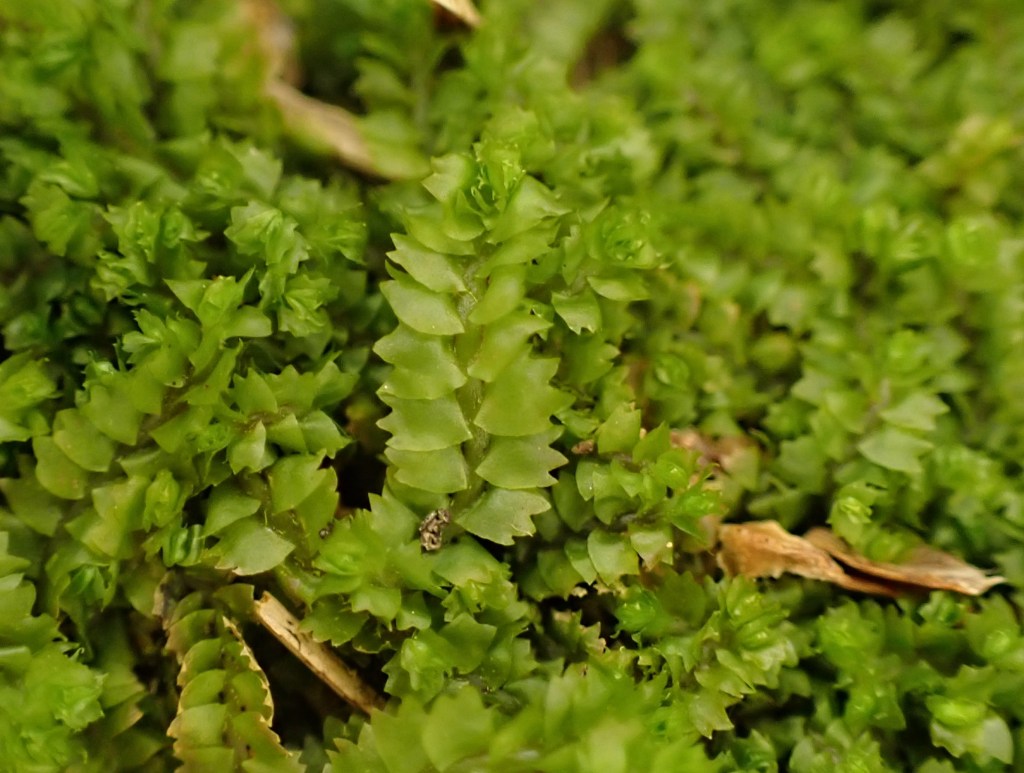
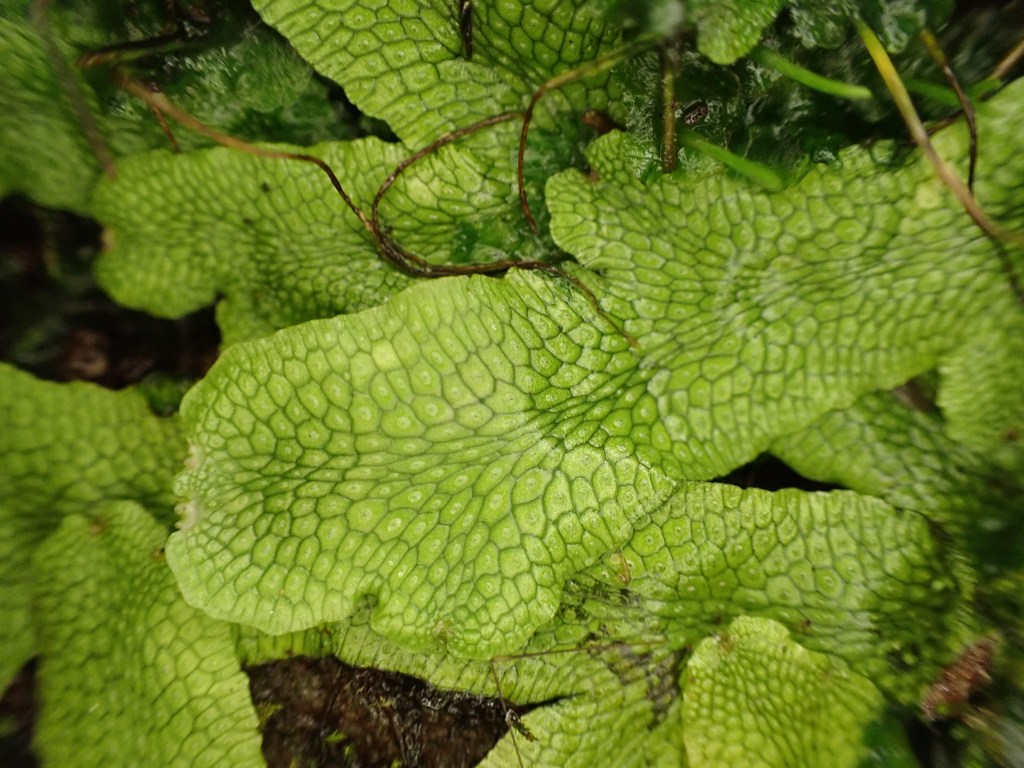
Above left: The leafy liverwort Lophozia barbata. Above right: The complex thalloid liverwort Conocephalum salebrosum.
Leafy Liverworts: Gametophytes
Leafy liverworts consist of a stem with rhizoids. There are 3 rows of leaves; two rows are laterally placed, and the third row consists as underleaves found on the ventral side of the stem, though they may be reduced in some species. The stems may be unbranched or branched to various levels. The rhizoids typically arise off the ventral side of the stem and may be scattered along the stem or found in groupings at the base of leaves.
Leaves are arranged in two fashions: incubous or succubous. When viewed from the dorsal (top) side with the growing tip at the top, if the top leaf lies under the bottom leaf, it is incubous. If the top leaf lies over the bottom leaf, it is succubous.
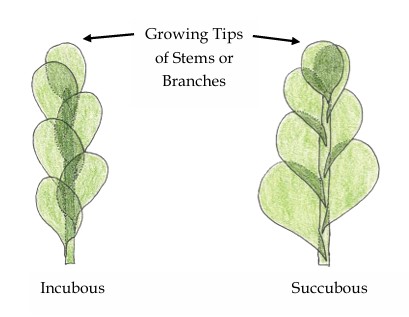
If viewed as a rooftop, incubous leaves would allow water to drain into the house. Succubous leaves are arranged like shingles and direct the water to run off of the roof.
The simple leaves of Porella platyphylla are arranged in an incubous fashion.
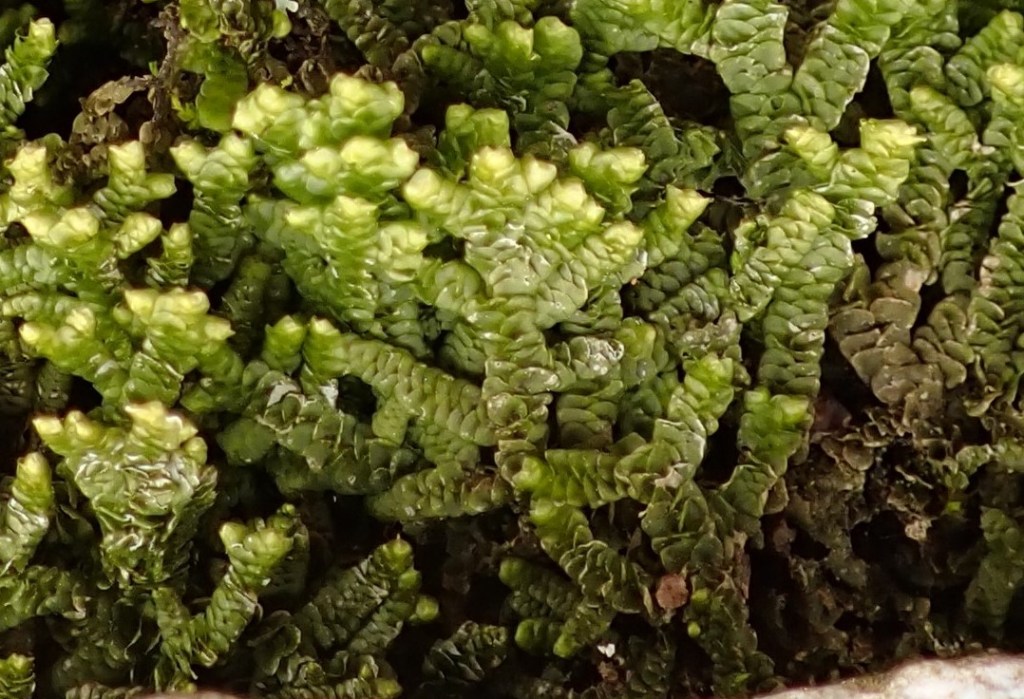
Leaves can be simple, or they can be complicate bilobed. They can be entire to bi-dentate, to toothed or ciliate.
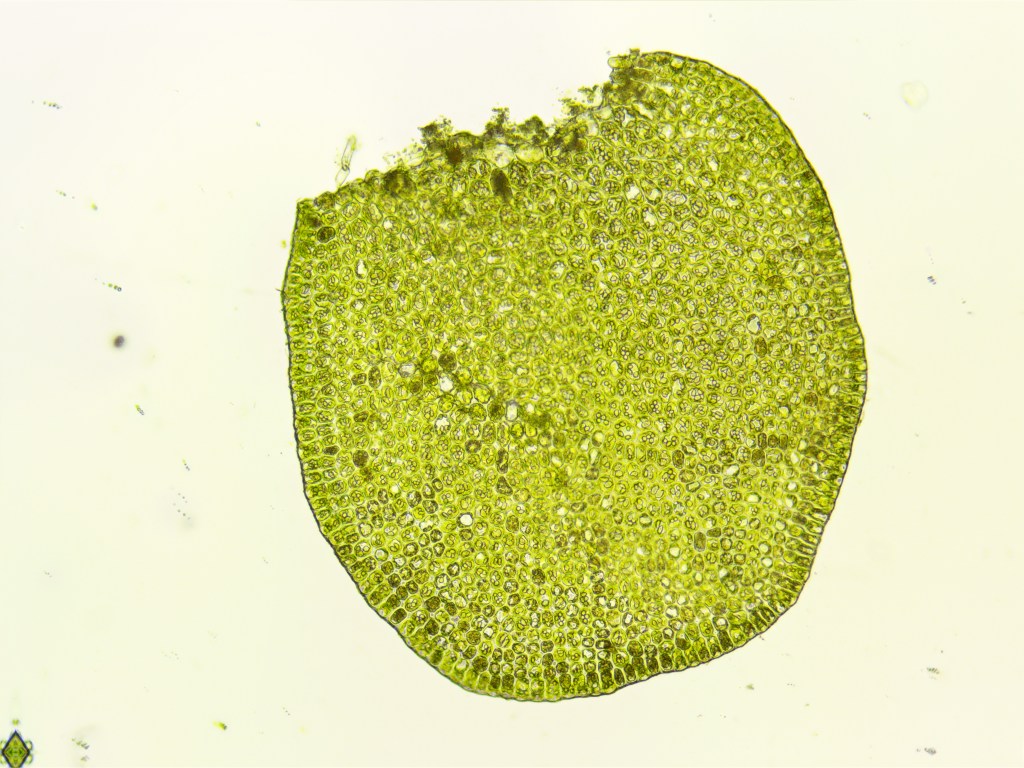
The simple and entire leaf of Odontoschisma prostratum.
The fuzzy looking Trichocolea tomentella is a result of highly ciliate leaves.
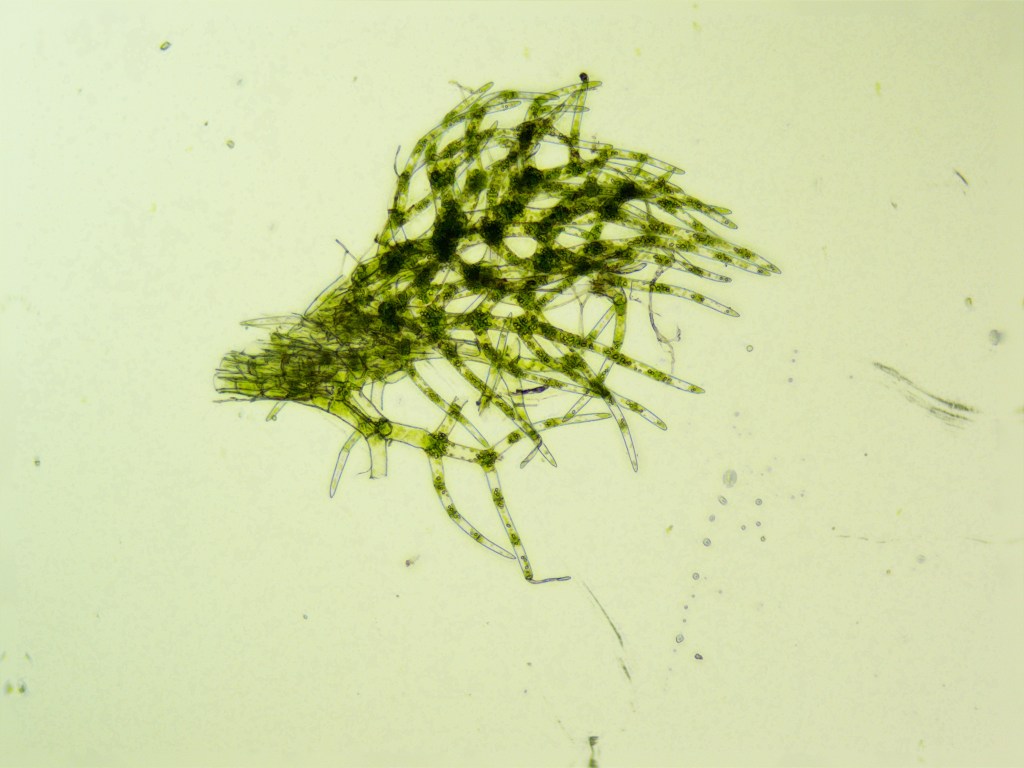
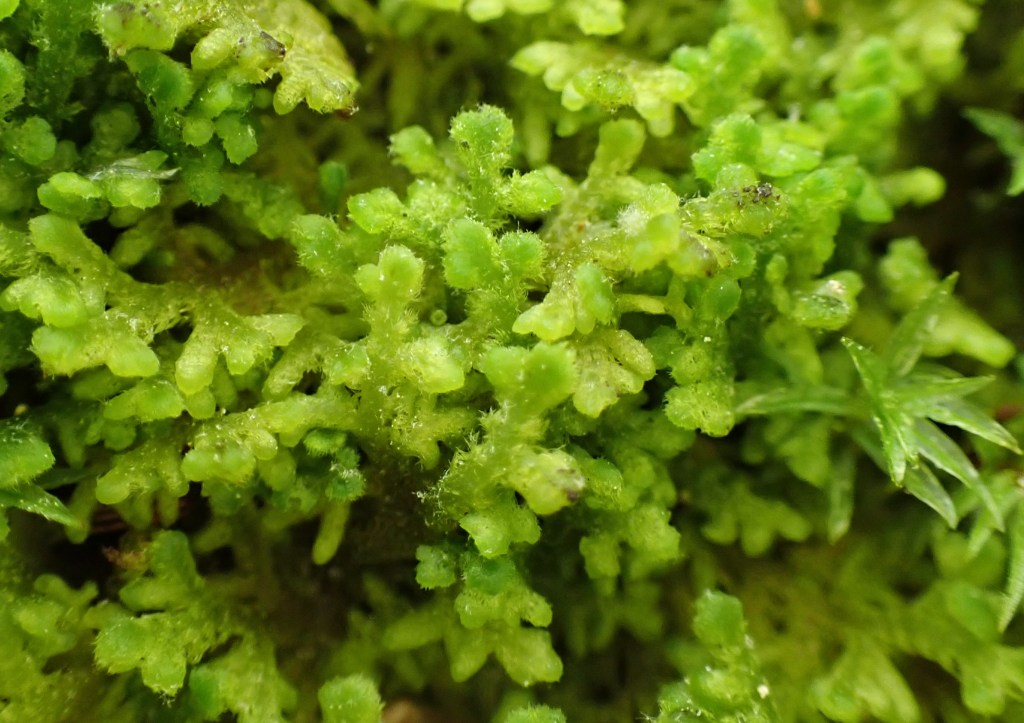
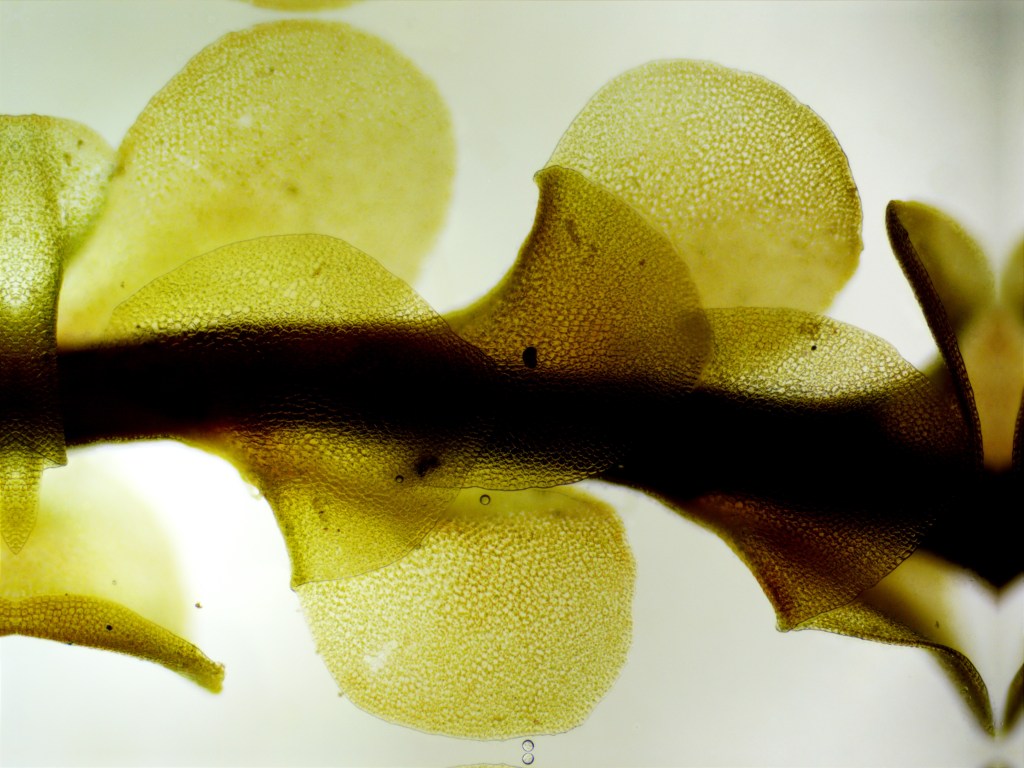
The complicate-bilobed leaves of Scapania subalpina. The leaves are bilobed and are folded together around the stem. An unfolded leaf is seen below.
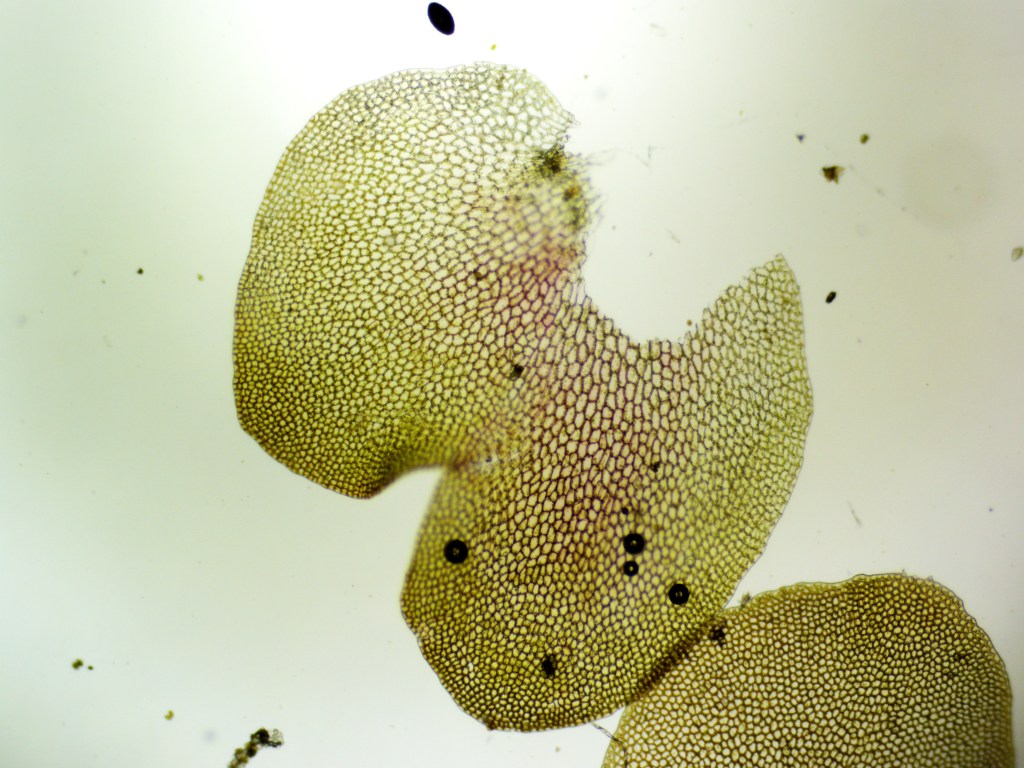
The complicate-bilobed leaves of Frullania riparia form a distinct keel that attaches the smaller, ventral lobule which is modified to form a helmet-like sac that aids in the retention of water. A stylus is seen at the base of the lobule about 4 cells long. The underleaves are bilobed.
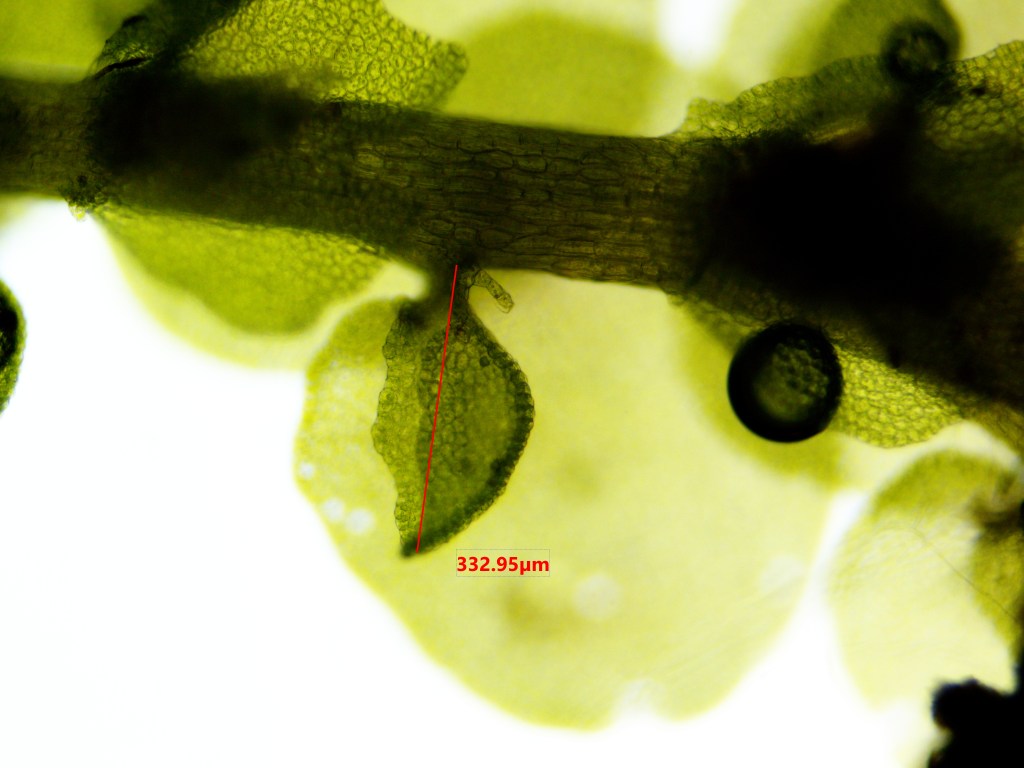
Underleaves come in several shapes and sizes, and some species lack them. They can be orbicular to lanceolate, to entire or bilobed.
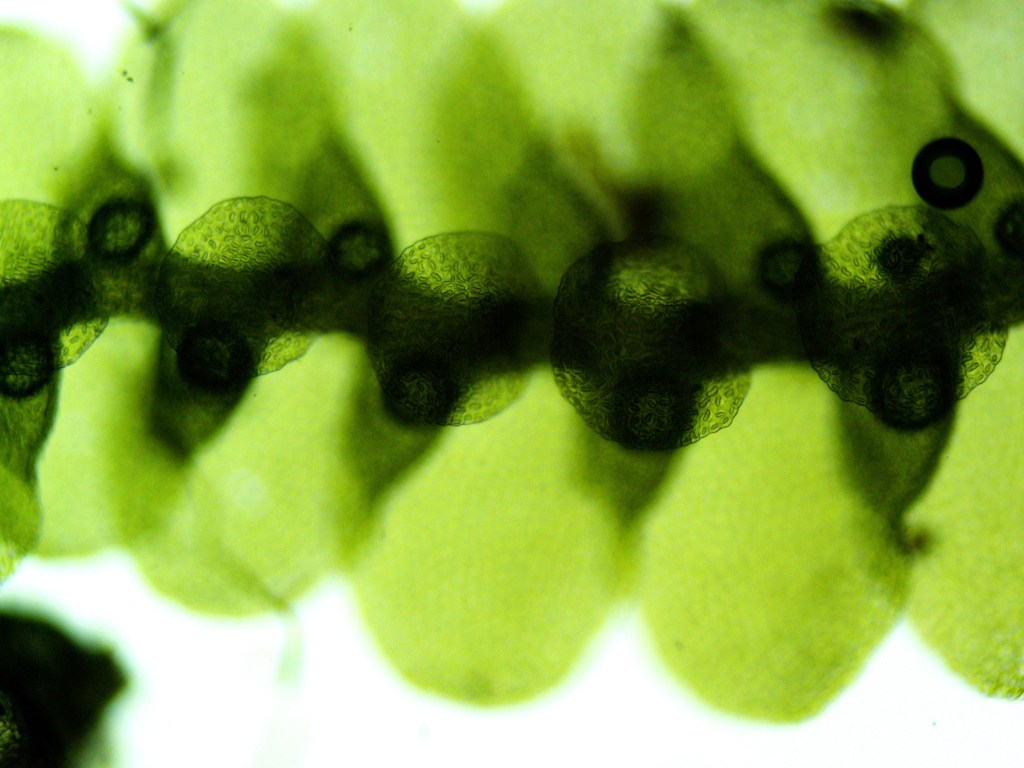
Leucolejeunea clypeata has circuluar underleaves.
Cells often have oil bodies that can be singular and large filling up almost the entire cell, to having many smaller ones. They can be spherical to oblong and be smooth or granulose. They are best observed in fresh specimens and are often helpful in determining species. As for their role, in short, they biosynthesize and store sesquiterpenoids. Many of these compounds have been found to have some sort of pharmacological activity.
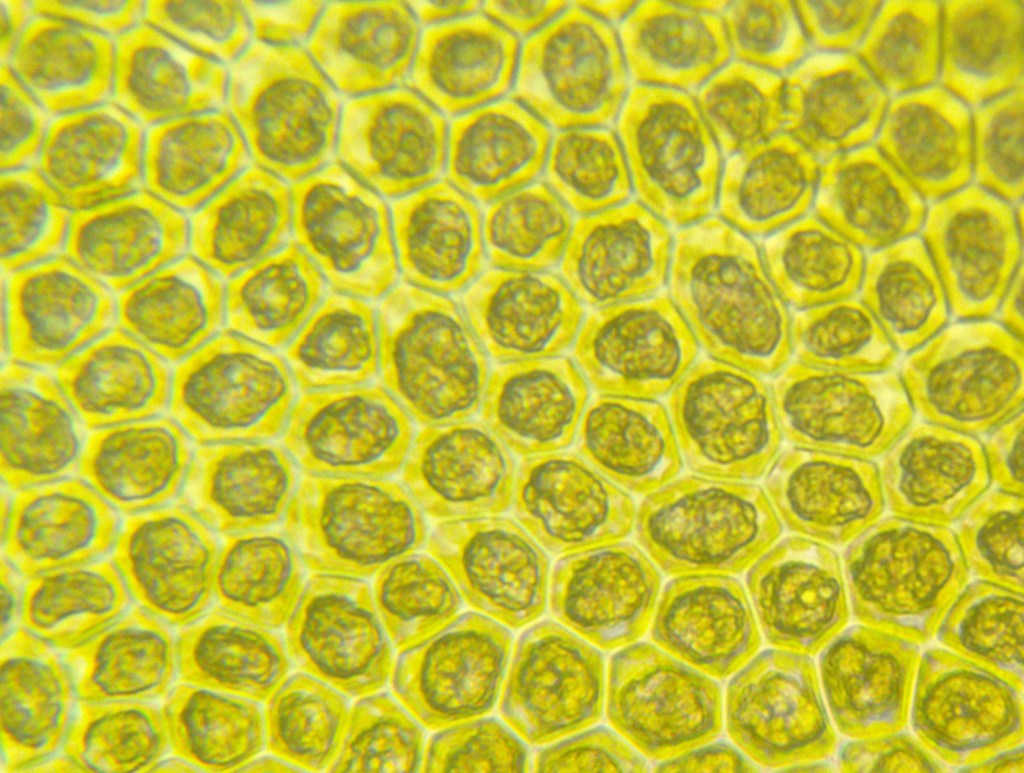
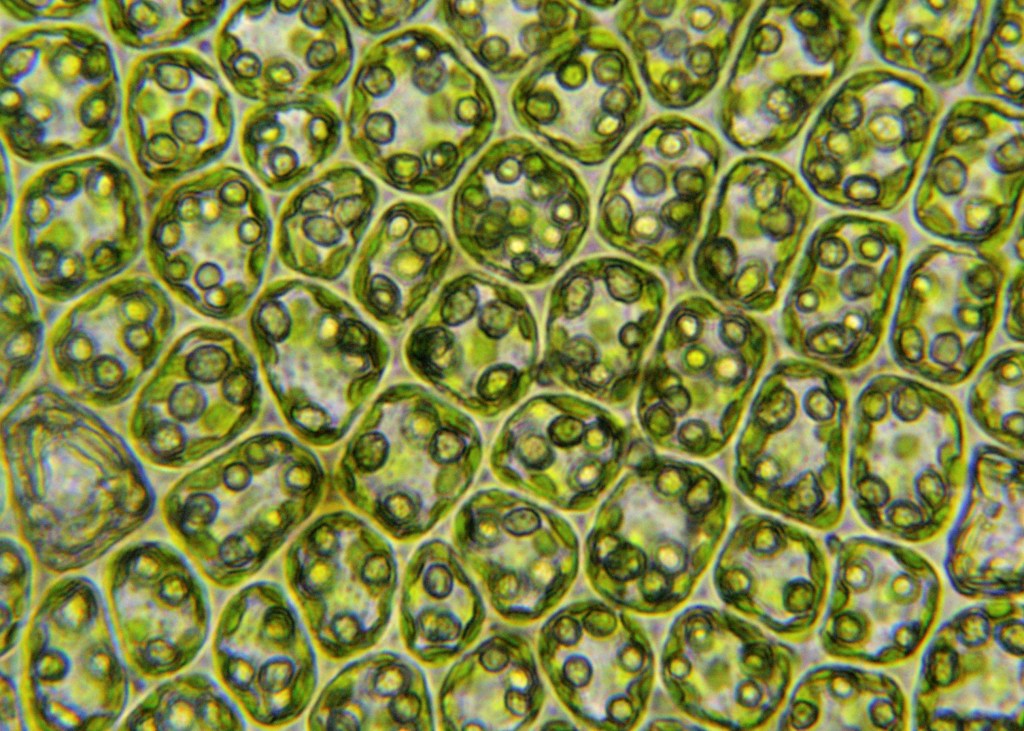
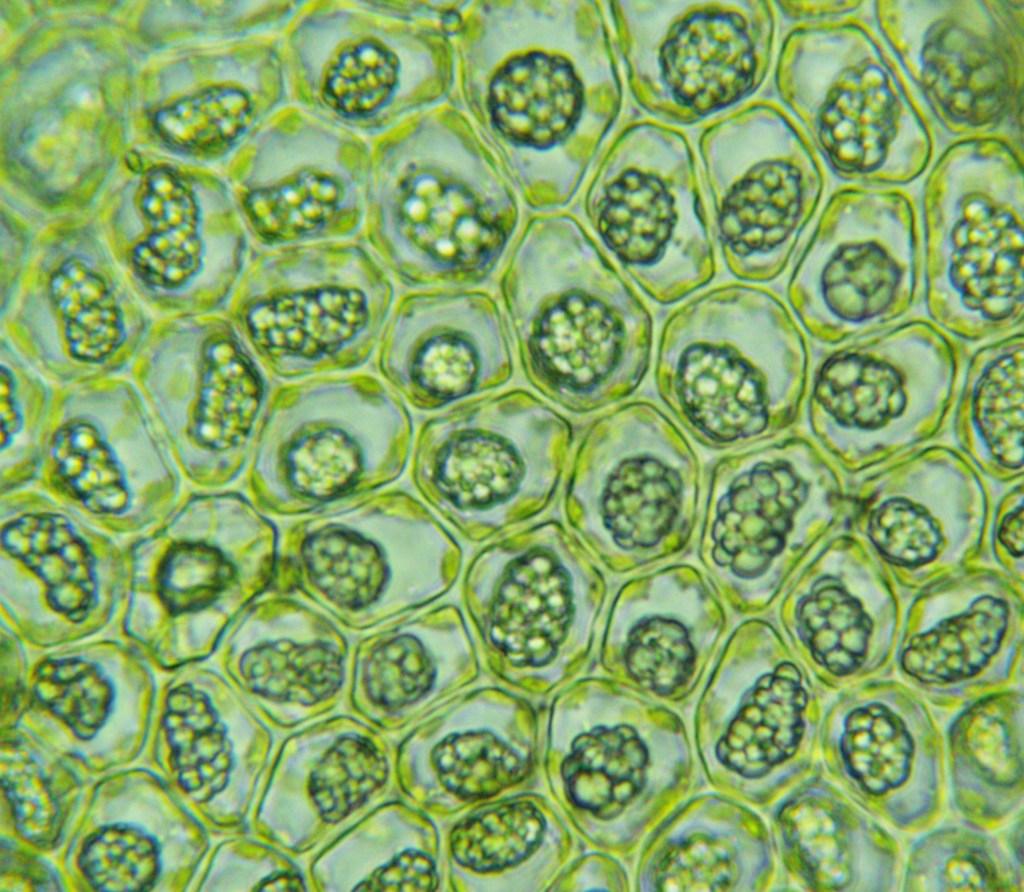
Above Left: Radula obconica has a single, large oil body; Above middle: Scapania nemorosa has numerous smaller oil bodies; Above right: Leucolejeunea clypeata has one single and very granular oil body per cell.
Leafy Liverworts: Sexual Reproduction
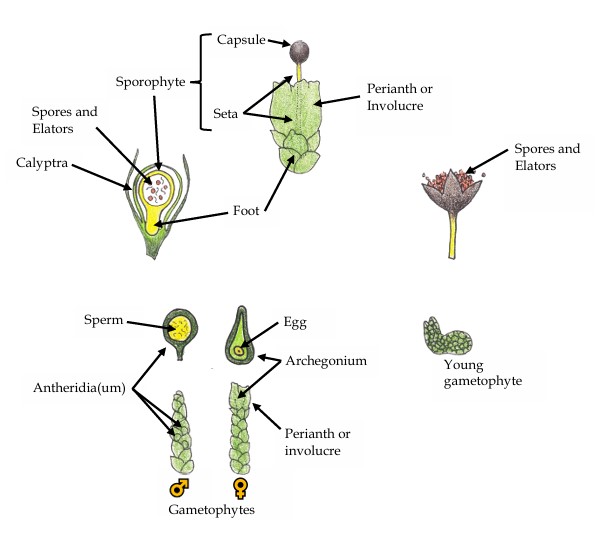
Plants can be monoicous or dioicous. The life cycle is similar to moss in that the sexual organs will eventually be produced on the gametophyte. Male sexual organs are called archegonia and produce sperm, and the female sexual organs are called archegonia and produce the egg. The archegonia are produced at the ends of shoot tips and are surrounded by modified leaves. The modified leaves fuse and are called a perianth. These can be helpful in deciphering species.
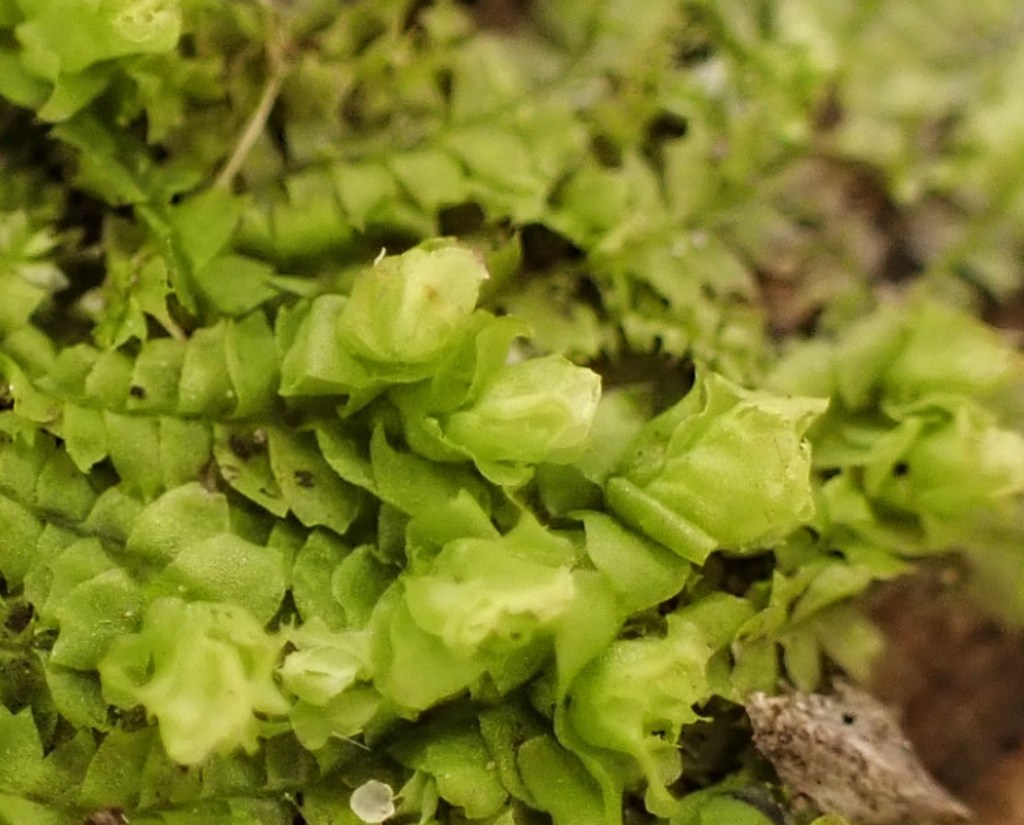
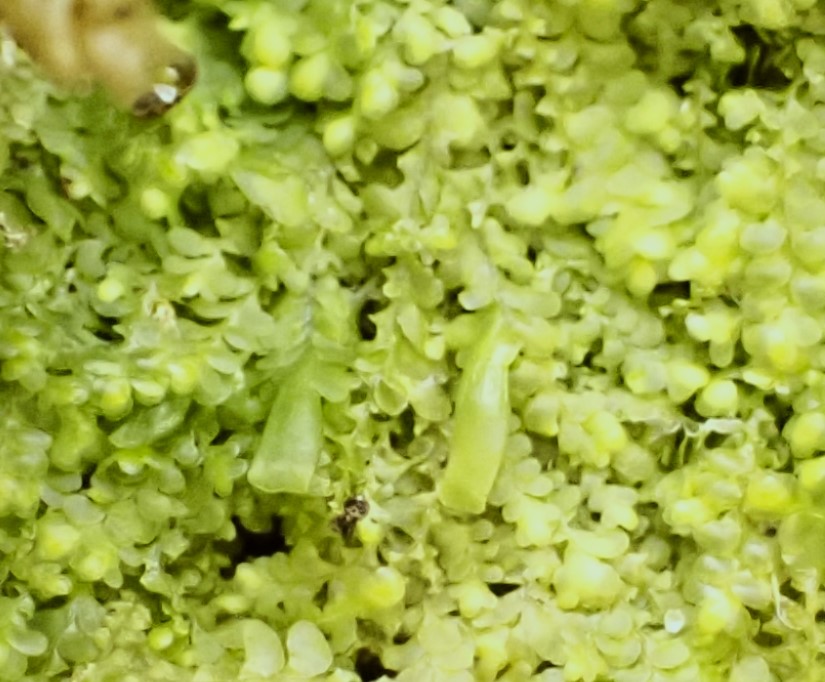
Above left: Perianths of Lophocolea coadunata; Above right: Perianths of Radula obconica.
Once fertilization takes place, the zygote is formed and will become the sporophyte. The sporophyte consists of the foot which is at the base, the seta or stalk, and the capsule. The capsule will produce haploid spores. Intermingled within the spores are elators which are spring-like structures that help to eject the spores.
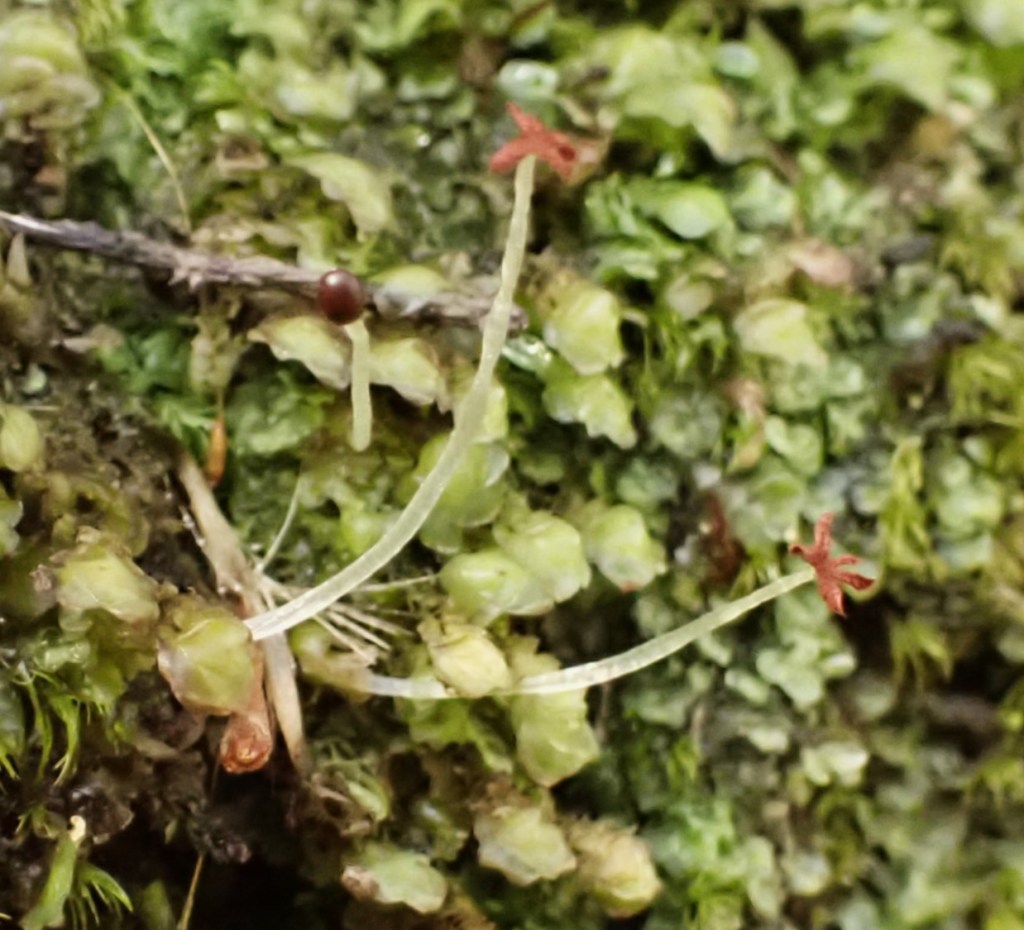
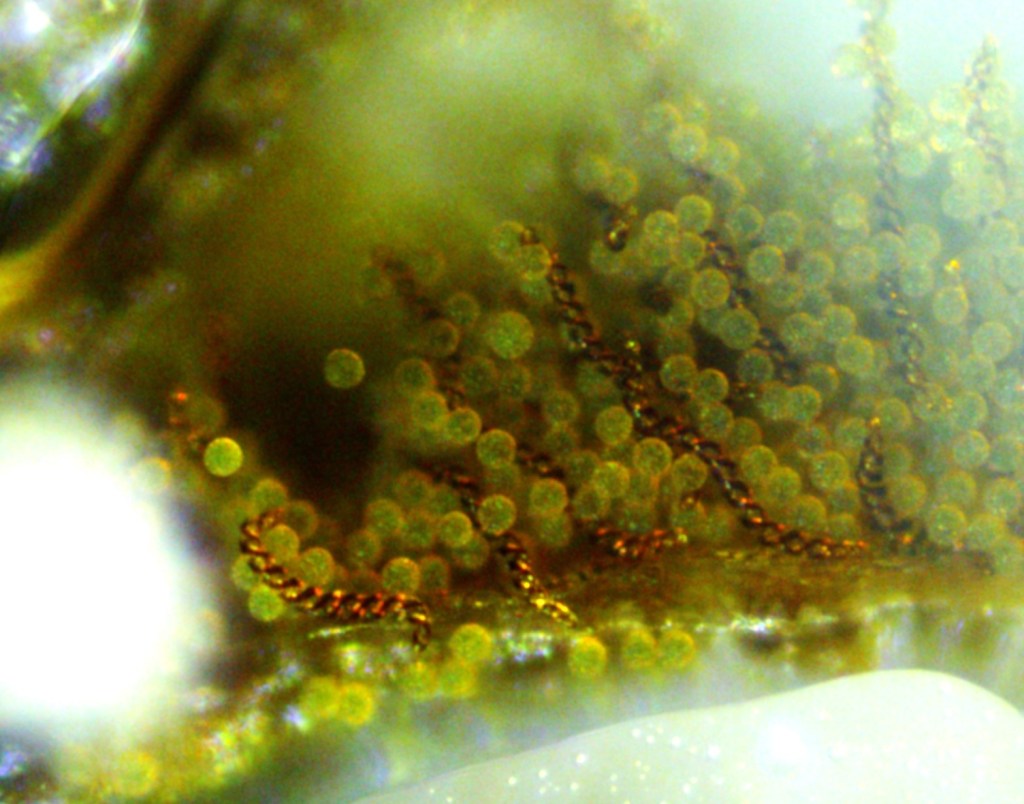
Above left: Closed capsule and two opened capsules of Scapania nemorosa; Above right: Spores and elators of Lophocolea heterophylla.
Leafy Liverwort: Vegetative Reproduction
Vegetative reproduction may occur by various methods in several species. These can be in the form of propagula such as gemmae and bulbils, as well as many plants being able produce deciduous pieces that break off and grow into a new plant elsewhere.
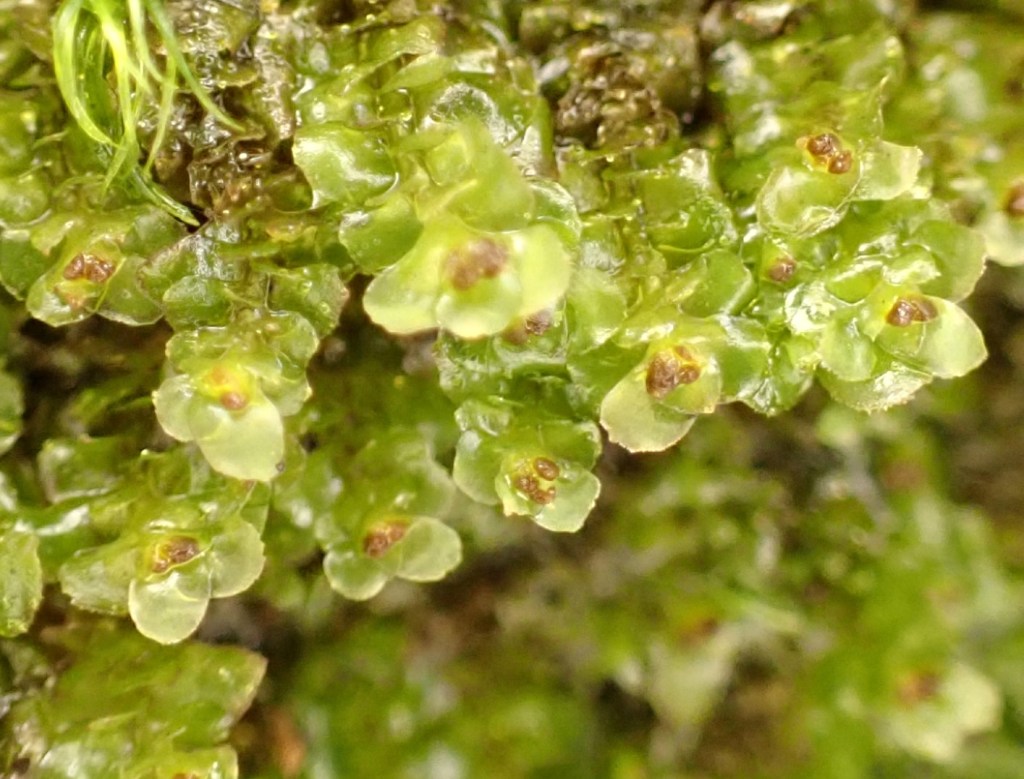
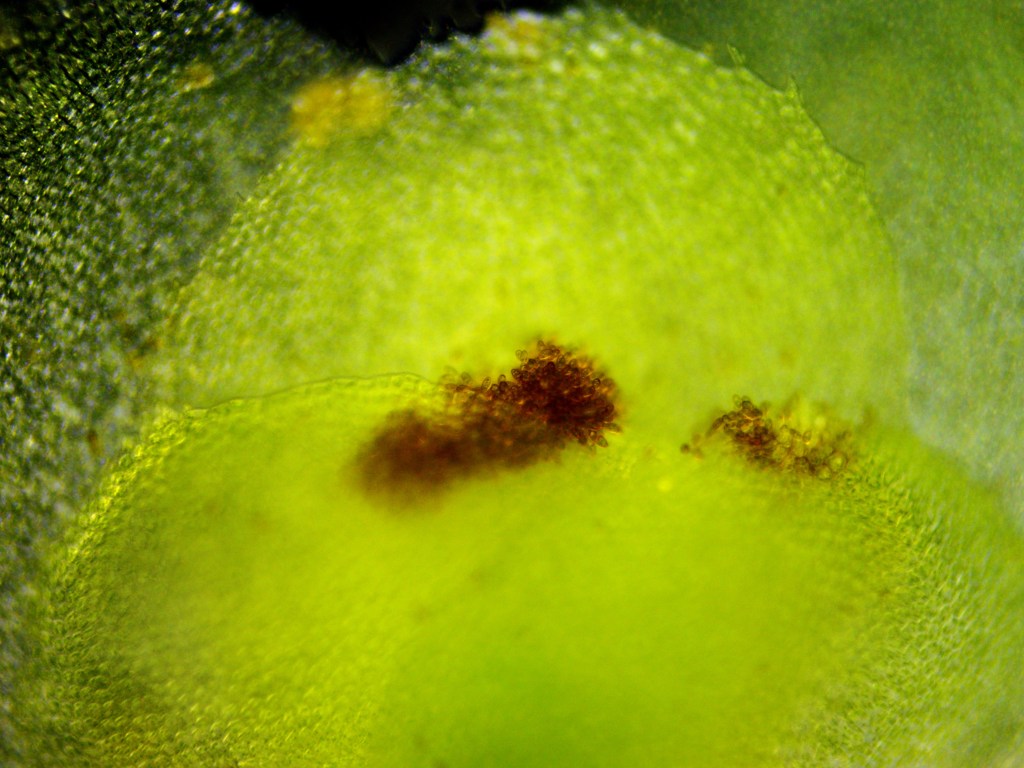
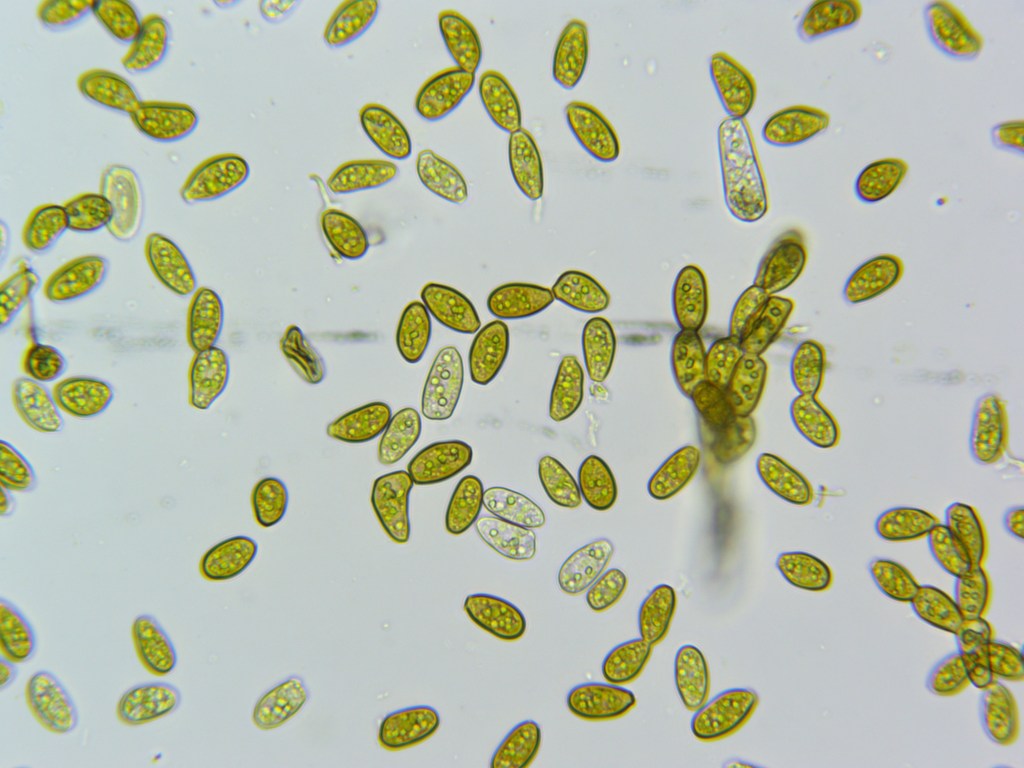
Above: Scapania nemorosa produces gemmae at the tips of the shoots that are single-celled and brown in color.
Thalloid Liverworts: Gametophytes
Thalloid liverworts lack a distinct stem and leaves. The body of the plant, called the thallus, may be one to several cells thick. The center of the thallus is thickened and can form a mid-rib area or in some cases, an almost stem-like structure with wings. Some groups have visible air pores at the surface, while others may be buried. The thallus can be rounded to ribbon like, and translucent to opaque.
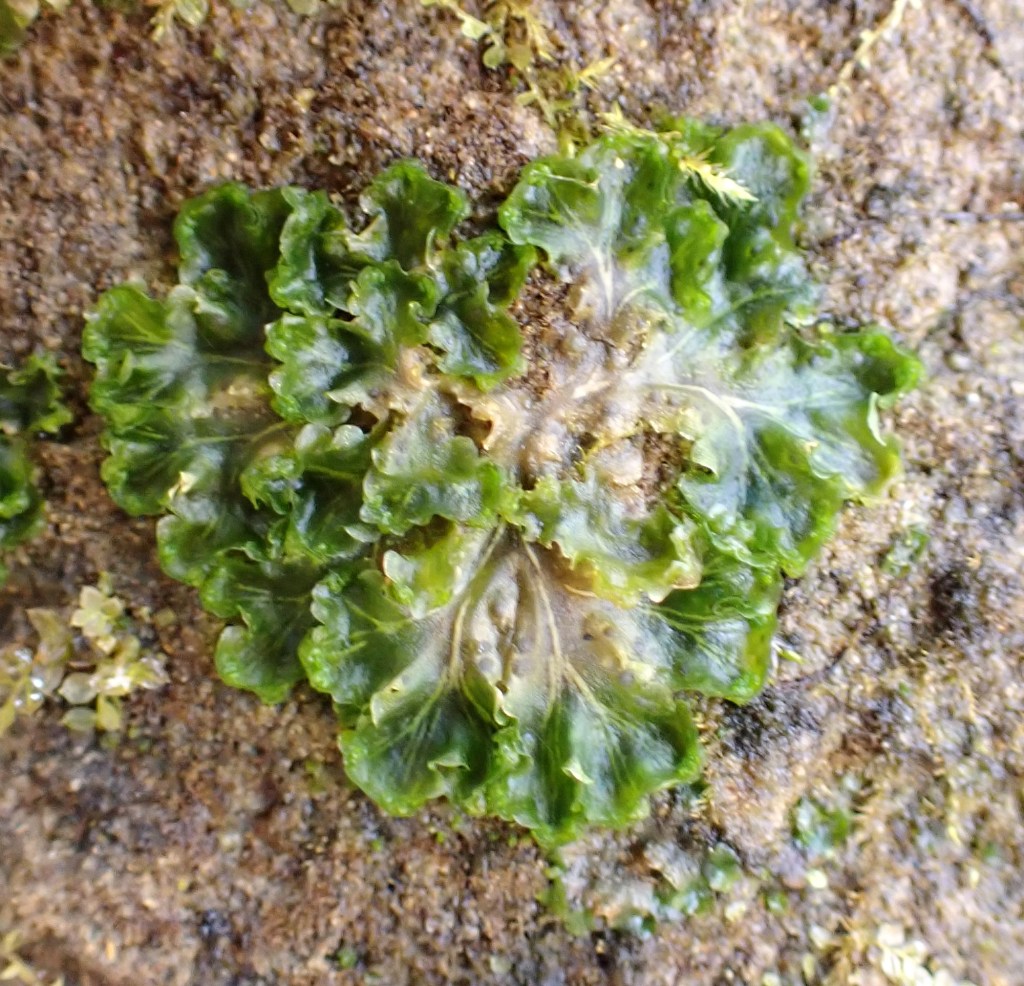
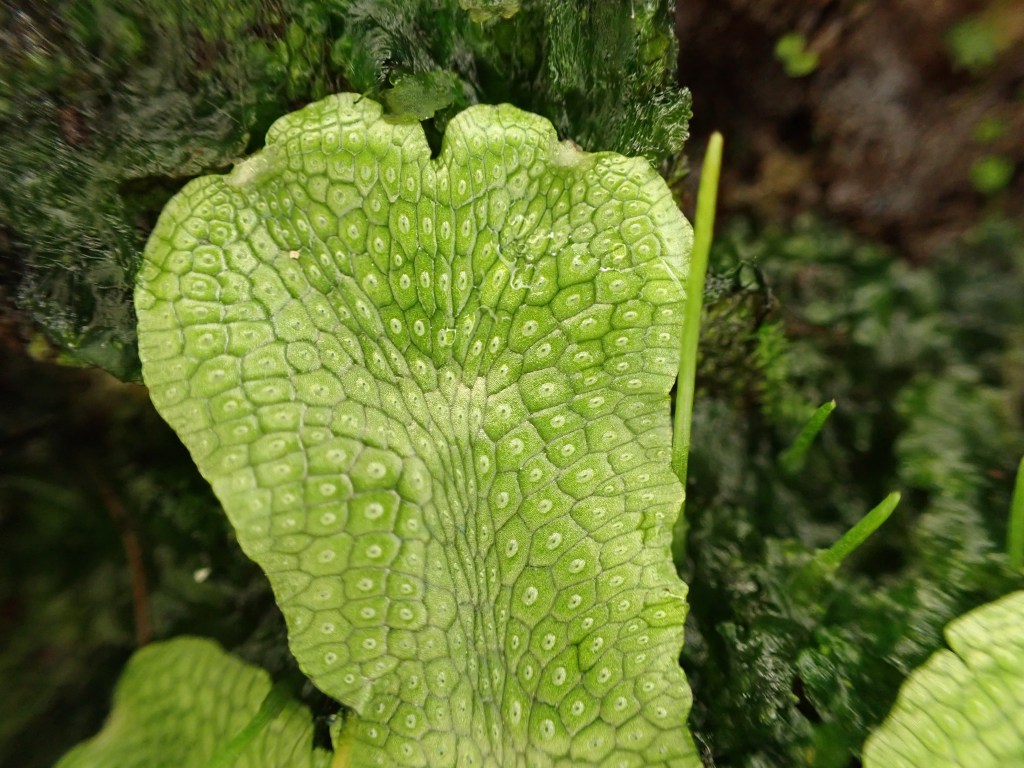
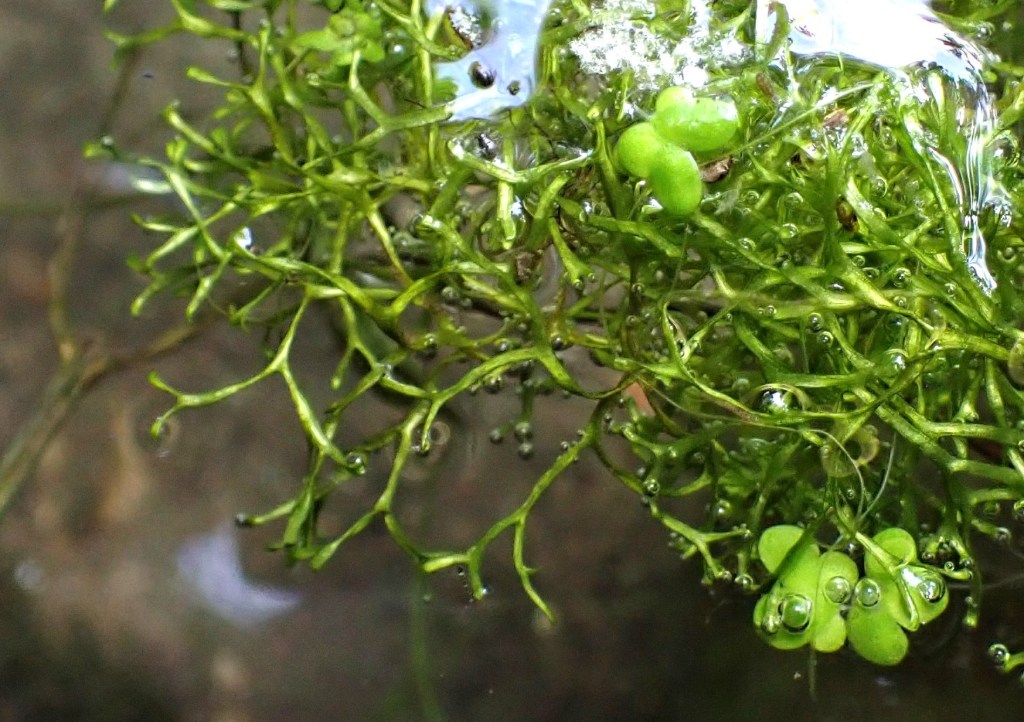
Top left: Blasia pusilla has a somewhat translucent thallus that grows in rosettes; Top middle: Conocephalum salebrosum, called snake-skin or great scented liverwort, has distinct air pores and an opaque thallus; Top right: Riccia fluitans grows in water as thin, ribbon-like strips with dichotomous branching.
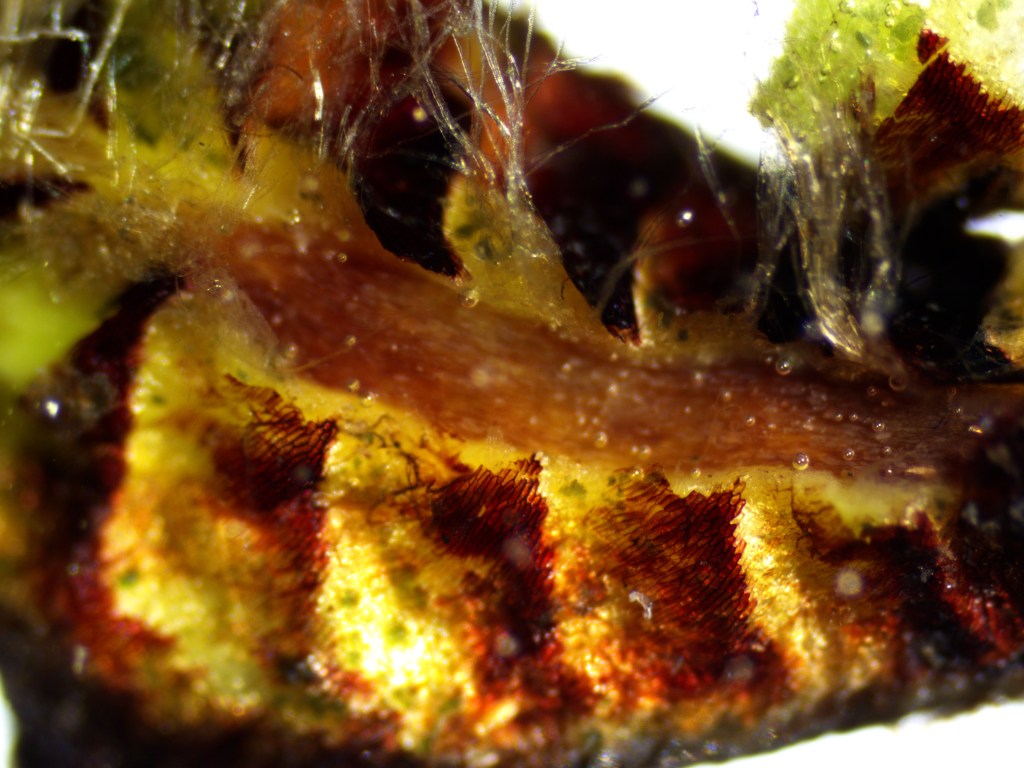
Rhizoids are found on the ventral side, where scales may also be found. In Reboulia hemisphaerica, the ventral side is purple with two rows of lunar-shaped scales.
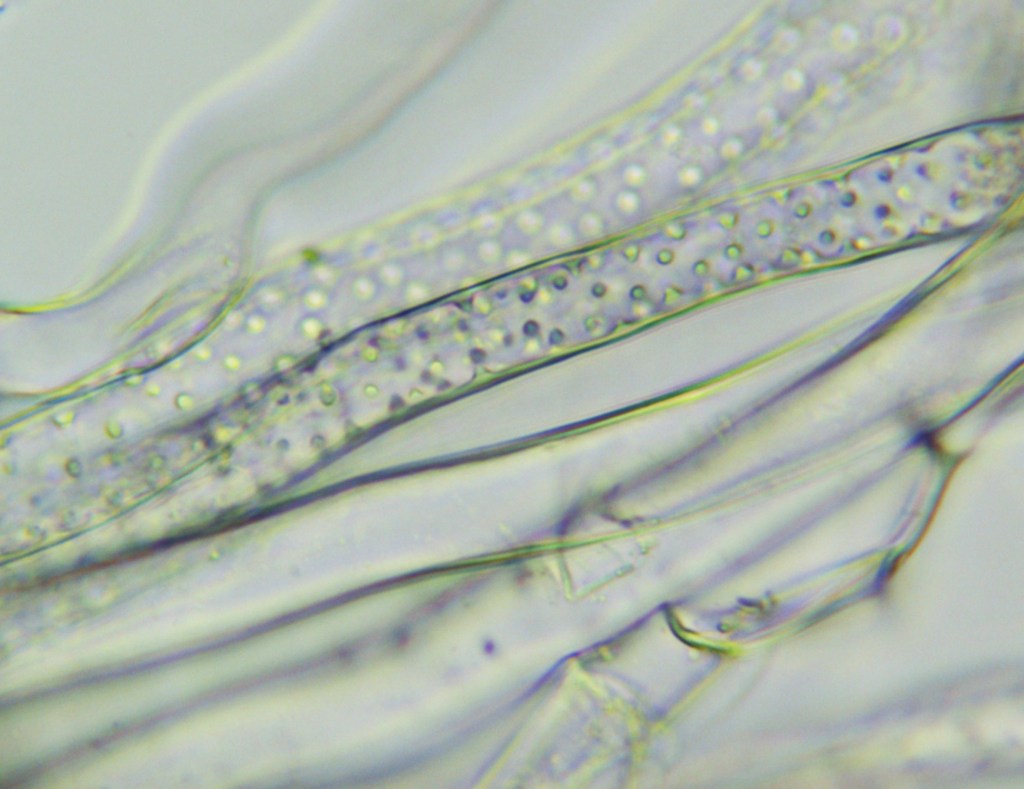
Rhizoids can be pegged or smooth, and is some cases, a species may have a combination of both.
Thalloid Liverworts: Sexual Reproduction
The overall reproductive cycle of the thalloid liverwort is similar to the leafy liverwort, but the formation of the male and female sex organs may be different. The archegonium (female) may be found at the dorsal surface of the thallus surround by an involucre (a ring of scales), with the antheridium just sunken into the surface. Alternately, the sexual organs may be produced within the body of the thallus itself, or one or both may be produced above the body of the thallus from specialized structures called archegoniophores (female) and antheridiophores (male).
The Pellia genus is an example of the first scenario, whereby the archegonium may be found on the dorsal surface of the thallus surround by an involucre, and the antheridium are sunken into the surface. The resulting sporophyte will produce a stalk that holds the capsule away from the thallus.
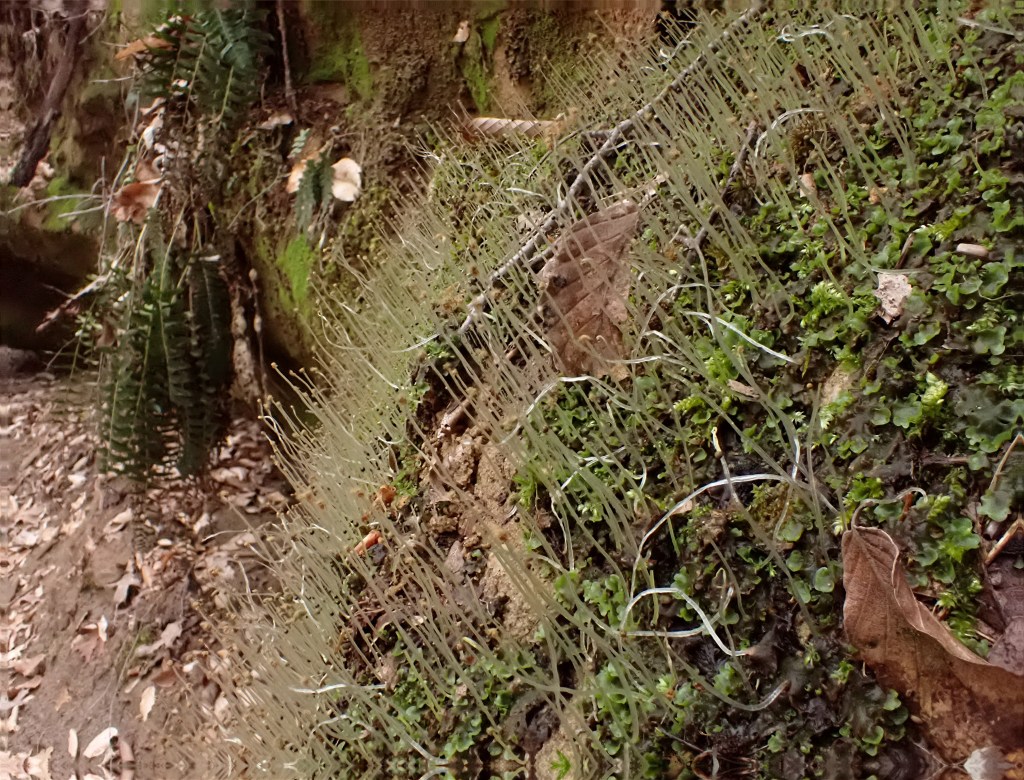
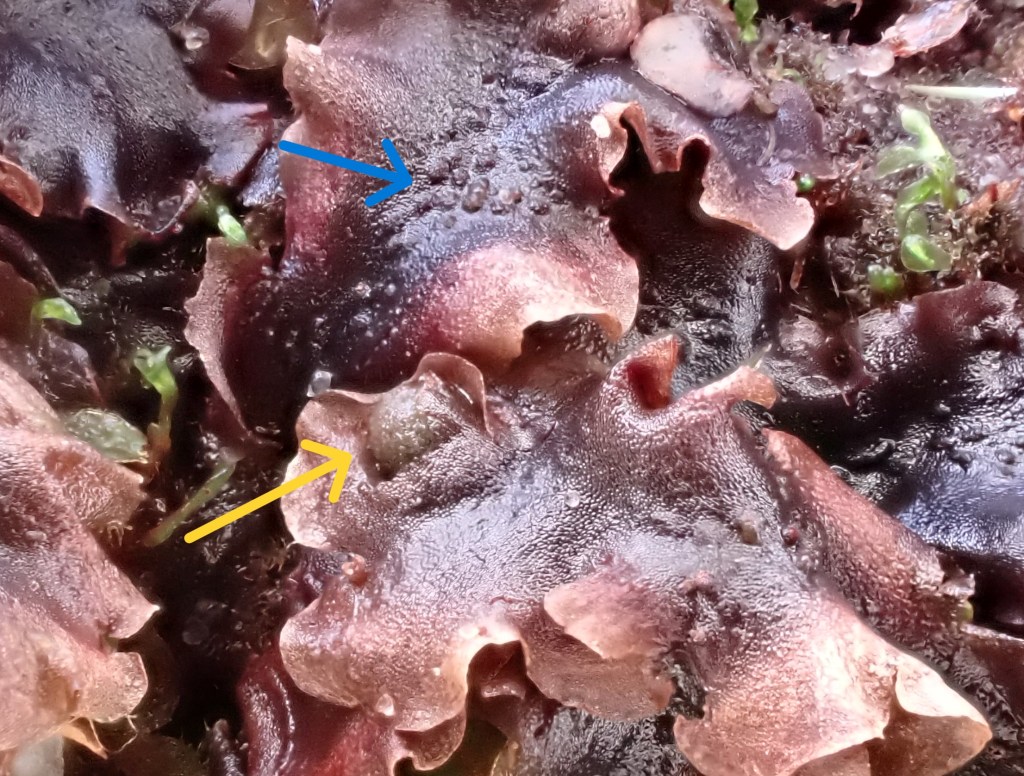
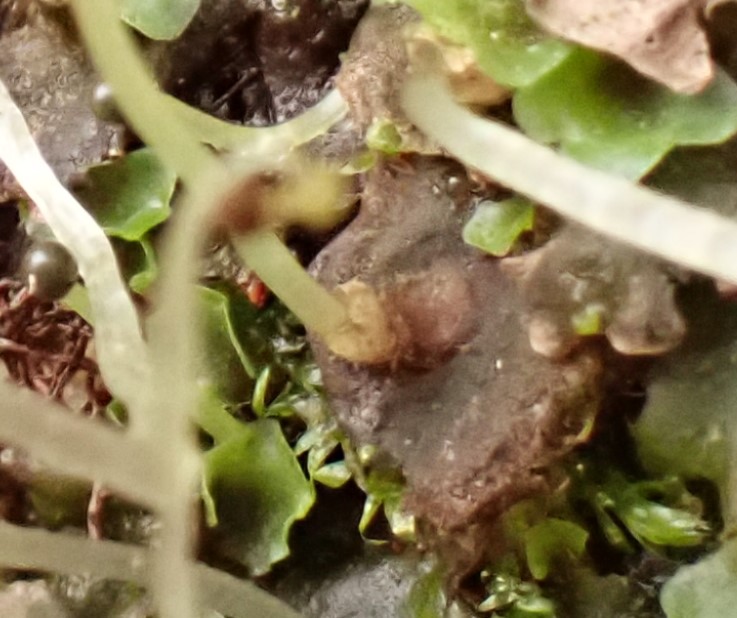
Pellia epiphylla; Top Left: Population with mature sporophytes, many with opened capsules; Top middle: Yellow arrow points to a forming sporophyte that is just peeking out from the involucre, and the blue arrow is pointing to antheridia; Top right: A mature sporophyte showing the involucre at the base.
The Riccia genus is an example where the archegonium (female) and antheridium (male) are produced within the thallus and remains in the thallus. When fertilization is successful, the sporophyte forms, and also remains in the body of the thallus. It will only be seen when the thallus degrades around it, eventually exposing the rounded vesicle with mature spores that are ready to be released.
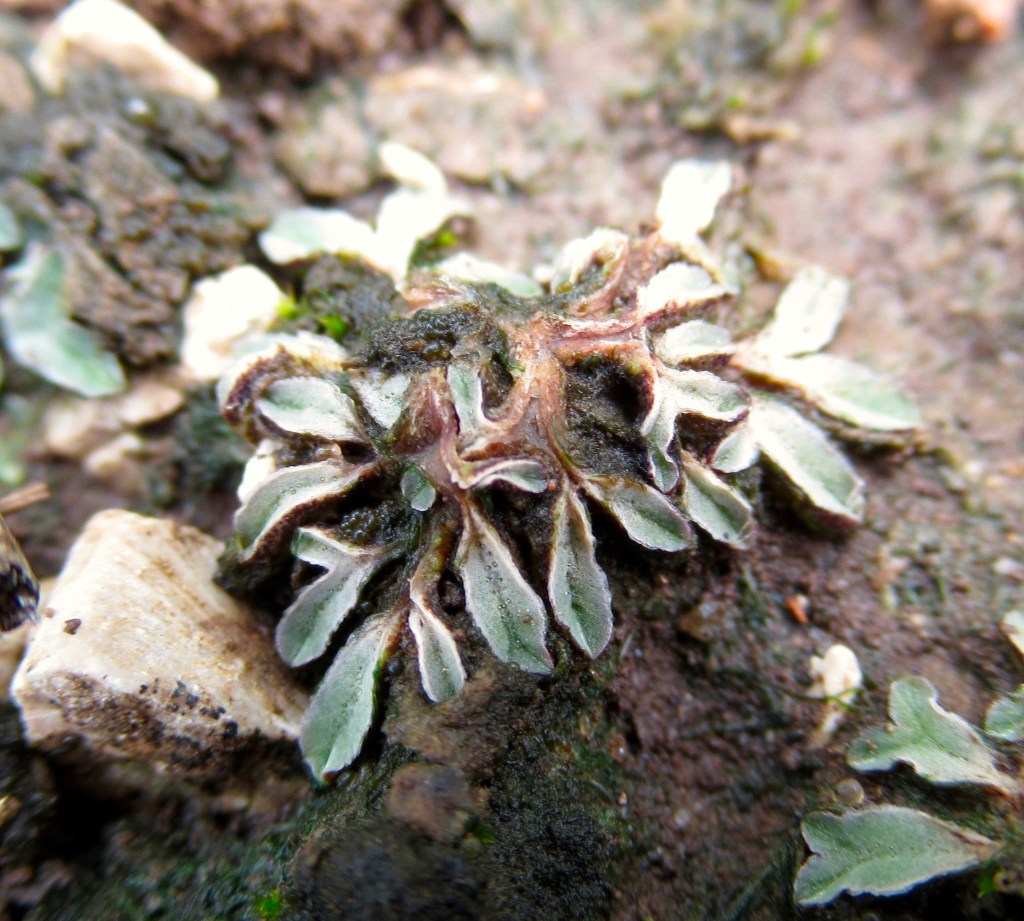
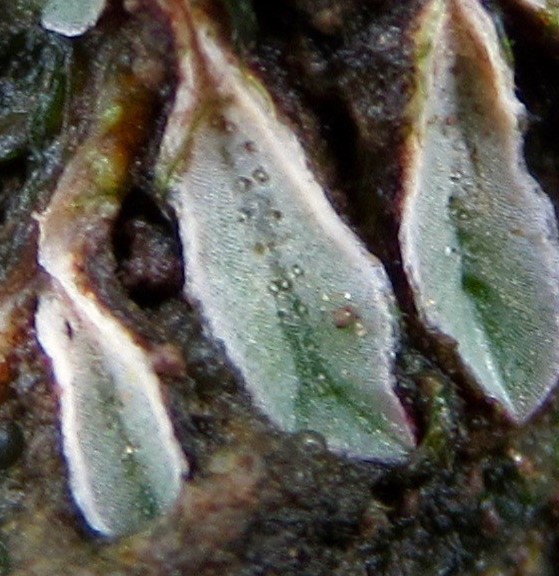

Riccia macallisteri; Top Left: Aging specimen; Top middle: Close up showing exposed, maturing sporophytes as the epidermis of the thallus disintegrates; Top right: Cross section showing the sexual receptacles buried in the thallus.
Marchantia polymorpha is a species where both the male and female gametophytes arise from the thallus body from a pedicle. The male gametophyte has a discoid shaped receptacle with antheridia embedded on the upper side. The female gametophyte has a tentacle-like, umbrella-shaped carpocephalum where the archegonium are eventually found underneath. The sporophyte will form here and stay sheltered under the carpocephalum.
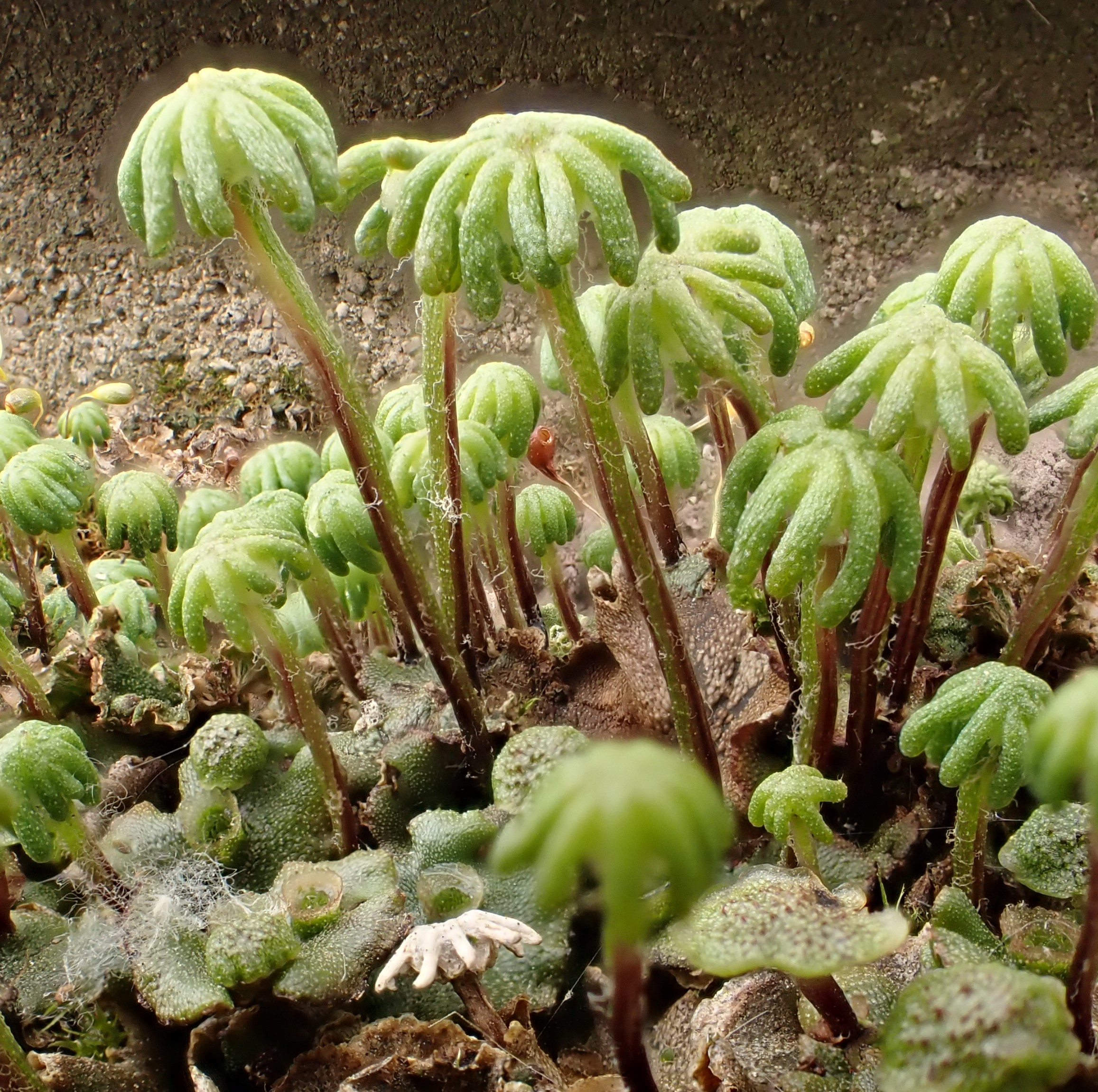
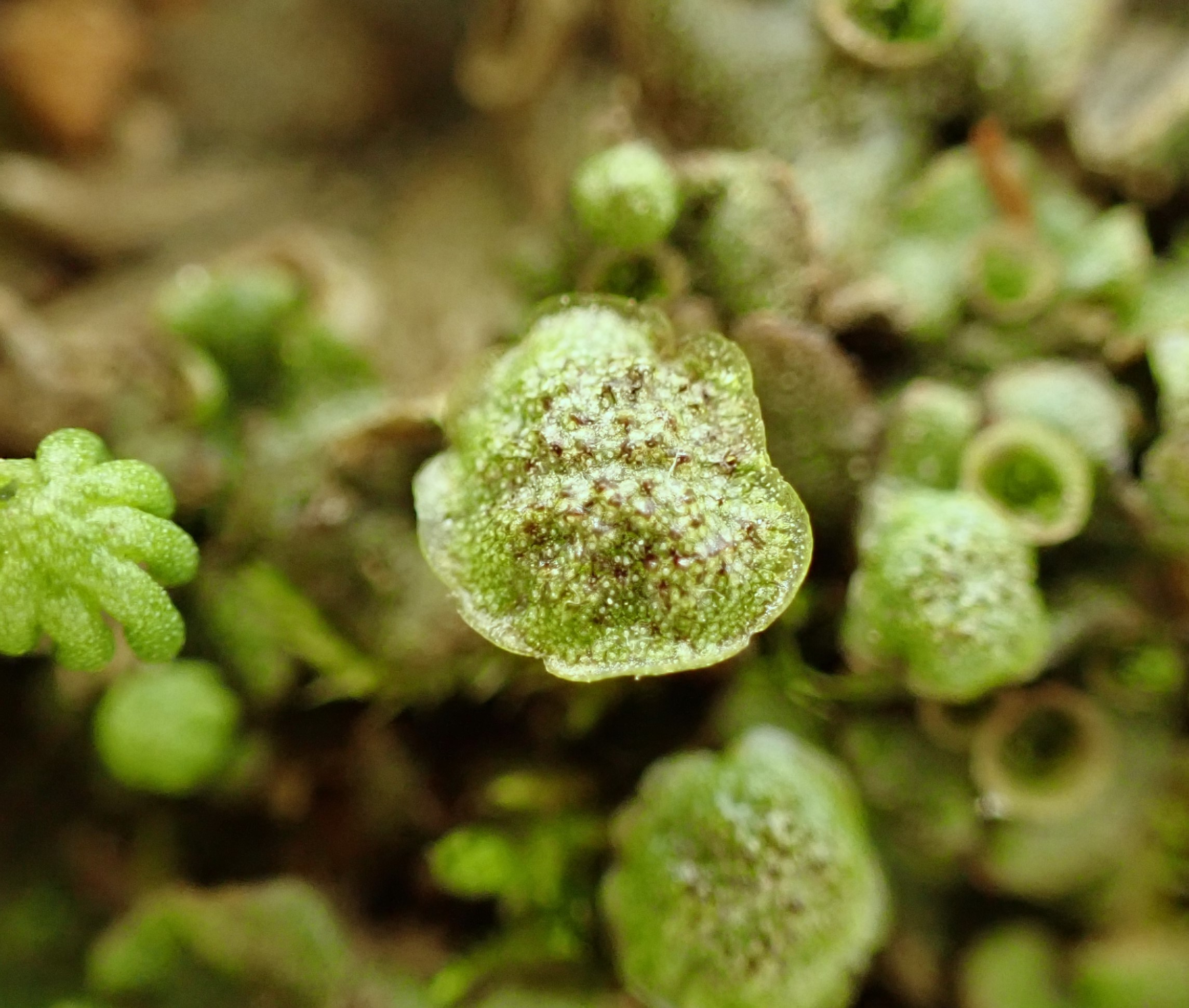
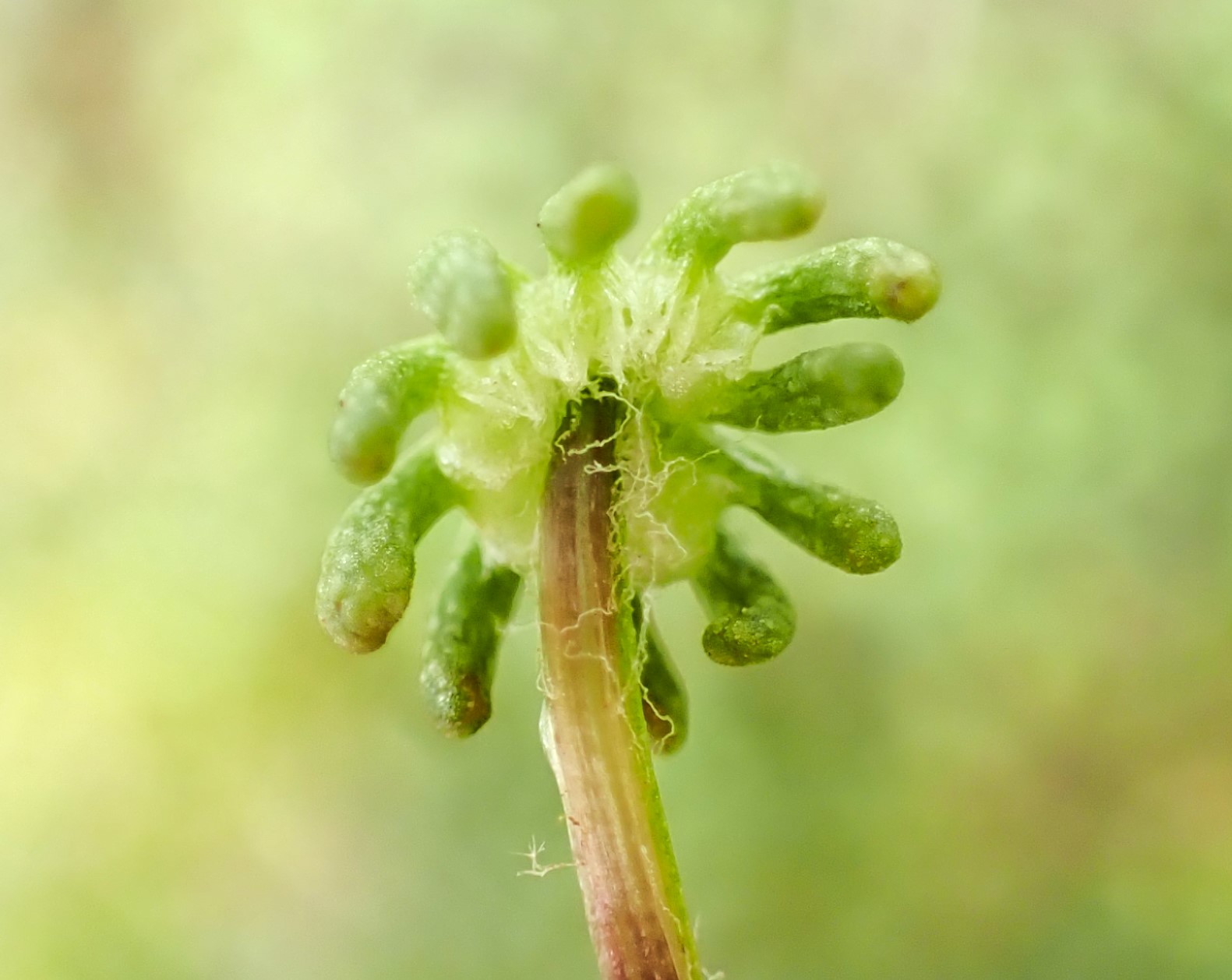
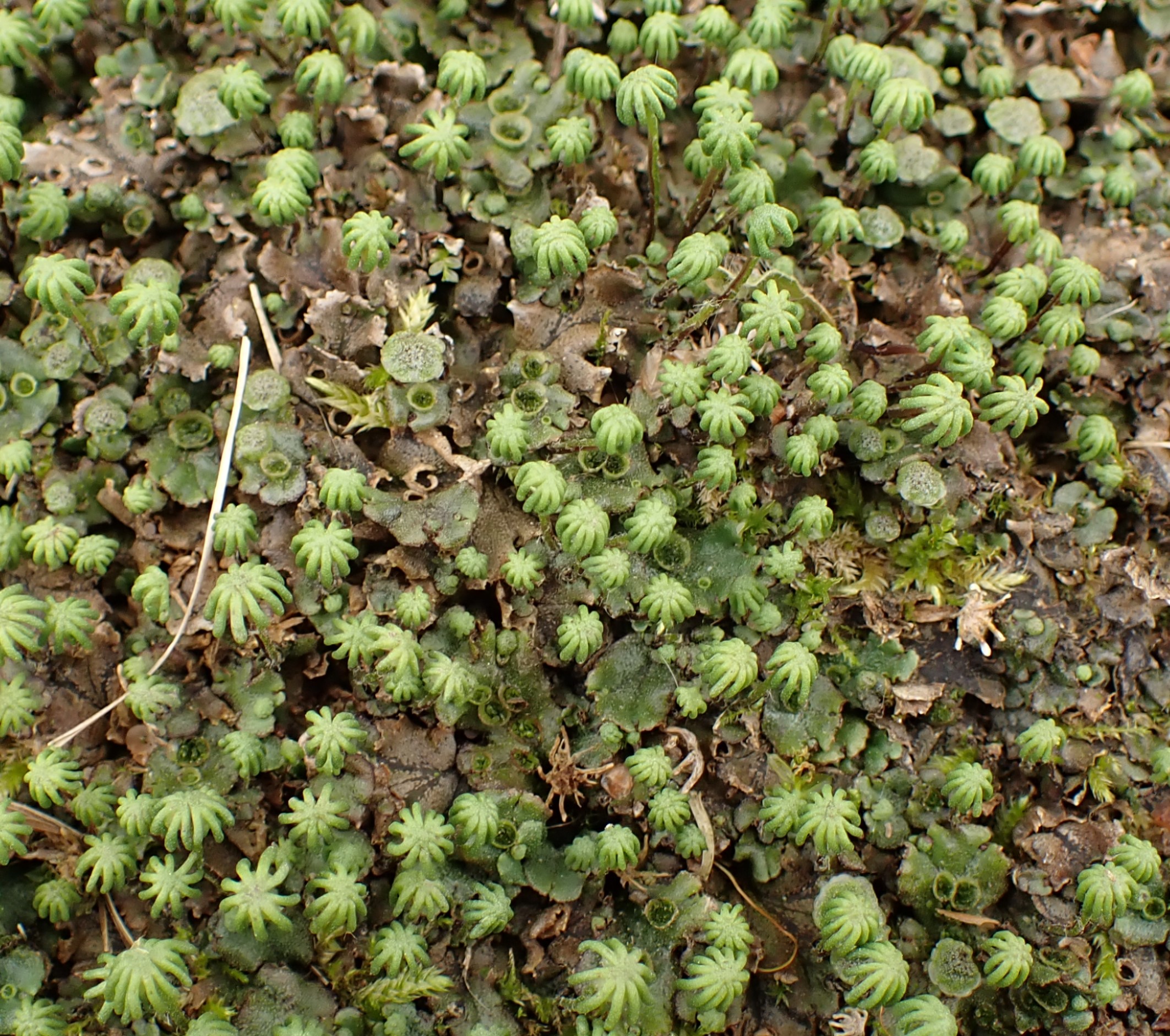
Top left: Female gametophytes with the tentacle-like, umbrella-shaped carpocephalum; Top right: Male gametophyte with discoid receptacle; Top right middle: Underside of female gametophyte’s carpocephalum with maturing sporophytes buried in the perichaetium. As the sporophyte matures, it will elongate just below the perichaetium and become visible with yellow capsules (not seen here); Bottom: Population showing various stages of reproduction, along with the vegetative gemmae cups.
Reboulia hemisphaerica and Asterella tenella are two species that have raised female gametophytes, but the antheridia remain buried in the thallus.
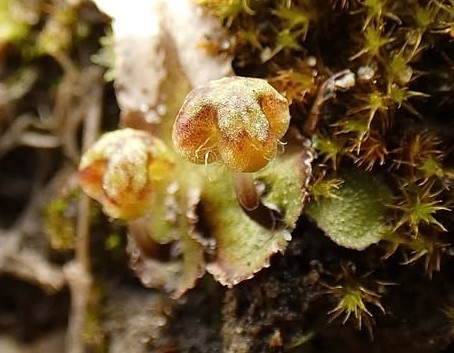
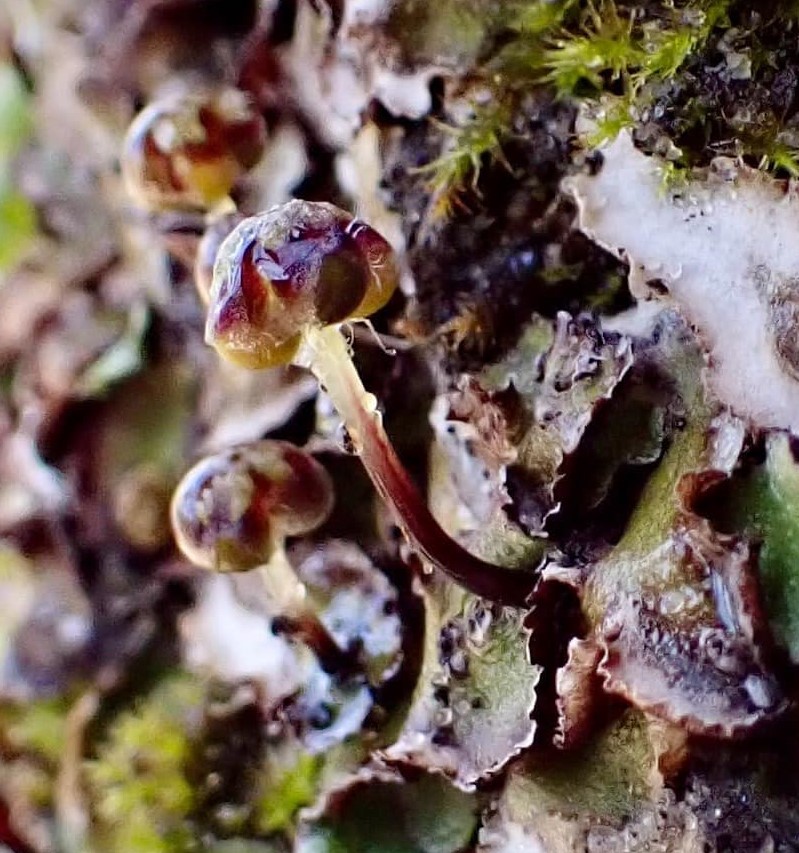
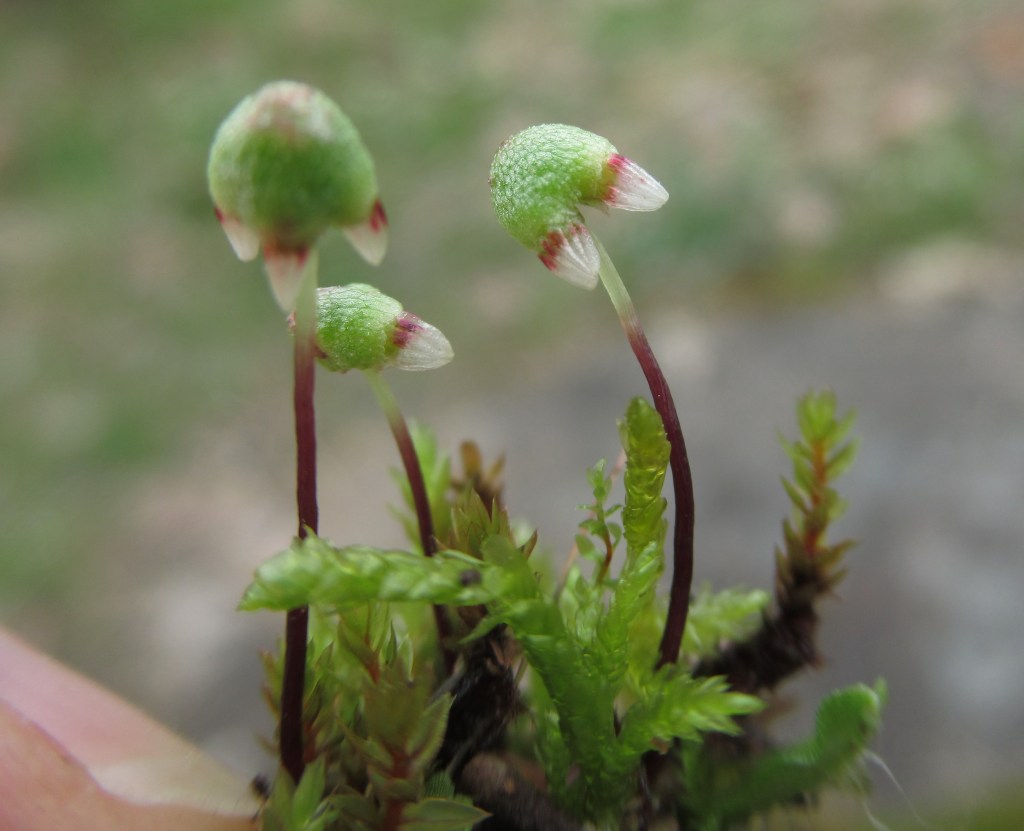
Top left and middle: Reboulia hemisphaerica with mature sporophytes, the capsules are close to dehiscing; Top right: Asterella tenella with immature sporophytes buried within the perichaetia.
 Mosses of Missouri and Beyond