I am thankful to have met a small group of wonderful nature lovers several years ago when I was asked to come verify ID’s for a self-guided moss walk that Louis Flenner was putting together for the Columbia Audubon Society at Wild Haven Nature Center. If you are in Columbia, MO someday and find you have time, it is worth visiting and going on the hike.
Since then, our small group which is comprised of birders, bryologists, geologists, naturalists, and probably a few more “ists” in there somewhere, try to get together several times a year to see what nature can teach us. Geology is important for bryology, and so having two geologists, Eric and Joanna Reuter in the group always adds so much more knowledge and history about the area. If you are wanting to learn more about geology in Missouri, you should check out their YouTube channel: Ozark Outsider.
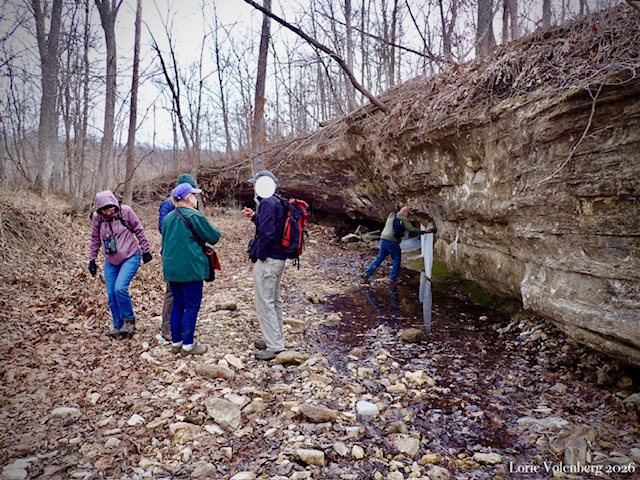
While most folks were preparing for the Superbowl, we decided to check out Danville CA near New Florence, Missouri. It offers both limestone/dolomite and sandstone-based communities to look at, along with some large glades. We started off in the bottomland where the St. Peter Sandstone is exposed. Sandstone tends to be more porous, thus allowing bryophytes to get a good foothold to grow. I did notice however, that there was minimal bryophyte activity in the sandstone shelter along the creek that faced west, and I wonder if it was due to the sandstone being very friable in that particular location. It didn’t take much for a sandstone chunk to fall from the wall and disintegrate. Calciphiles and tufa builders such as Hymenostylium recurvirostrum were about the only species attempting to grow on the walls. The calcium supply is coming from the limestone/dolomite layers above through water runoff and ground water leaking through.
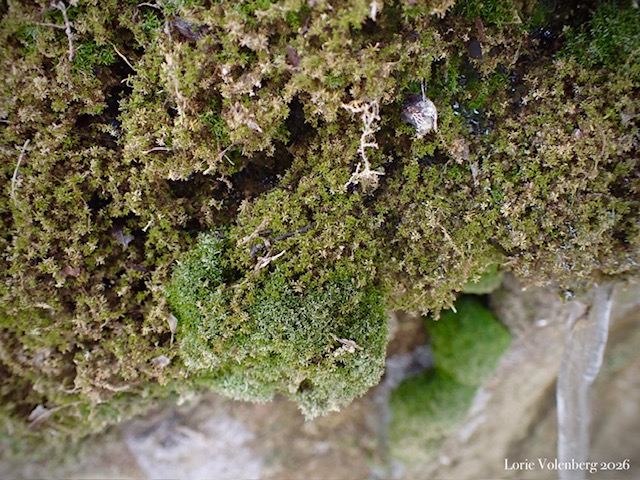
As we continued downstream away from the sandstone shelter, the sandstone itself firmed up a bit, and more bryophyte activity could be found on the walls and the ledges.
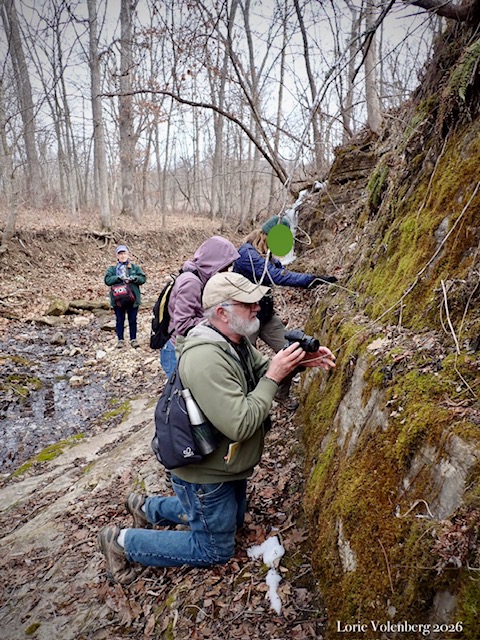
Species found on the vertical sandstone wall consisted of Campylium chyrsophyllum, Hygroamblystegium varium var. varium, a Fissidens sp., and the snakeskin liverwort Conocephalum salebrosum, just to name a few.
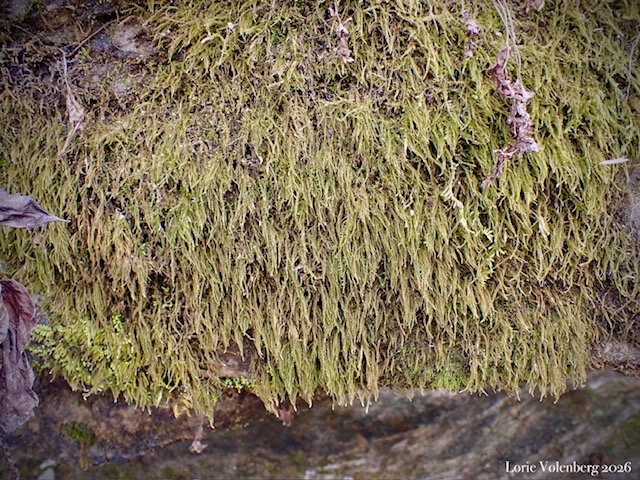
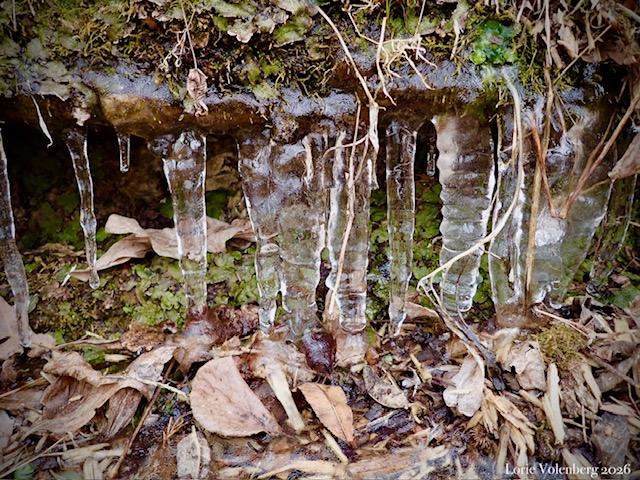
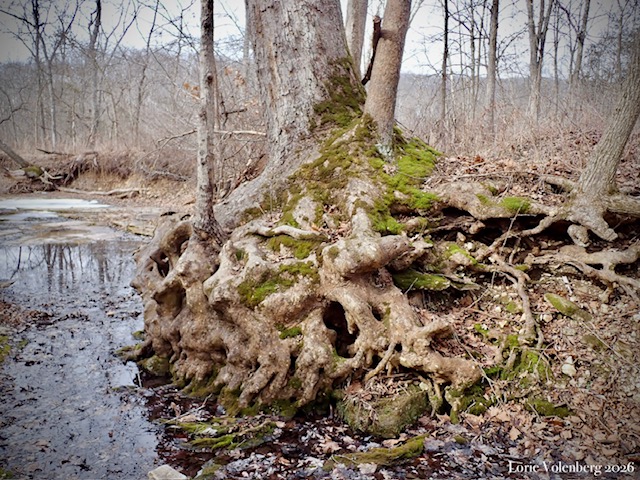
Left: Hygroamblystegium varium var. varium can form a beautiful pattern when it gently cascades down a rock face; Middle: Conocephalum salebrosum is protected behind its icicle guardians; Right: The root system of this Sycamore tree was absolutely stunning!
The creek is a seasonal creek that always has some water flowing and probably sees mostly just seasonal fluctuations in water level due to rain and snowmelt. A number of species were growing on the exposed bedrock including two types of Hypnum, and Barbula unguiculata. The Barbula threw me for a loop as it didn’t have the typical distinct claw tips that is known for that species. I wonder if the more wet-mesic environment sent signals saying that it wasn’t necessary to produce such a tip. Awns have been shown to aide in water collection, and I wonder if the same applies to apiculate tips.
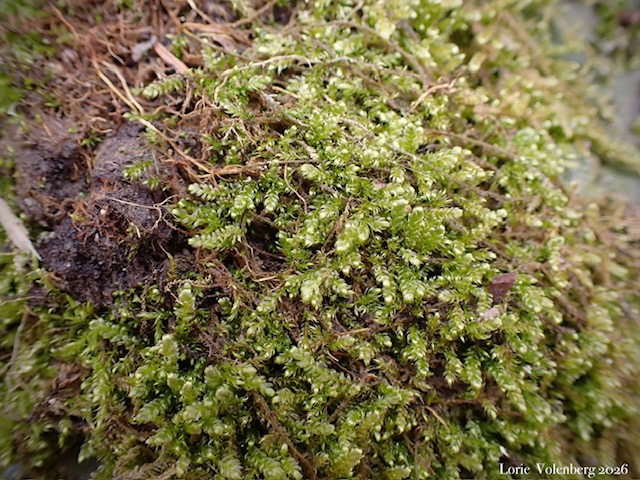
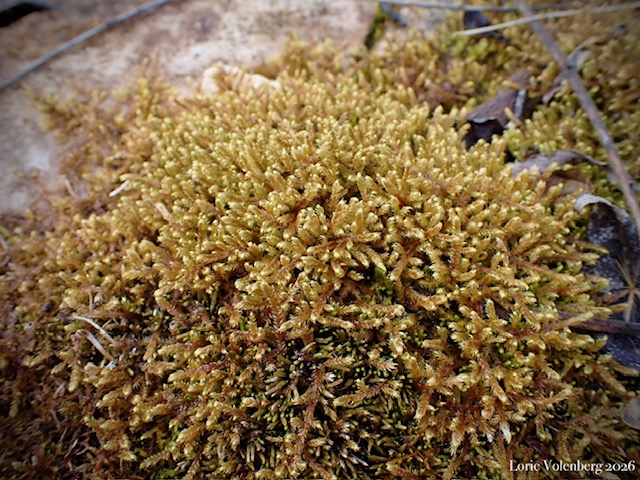
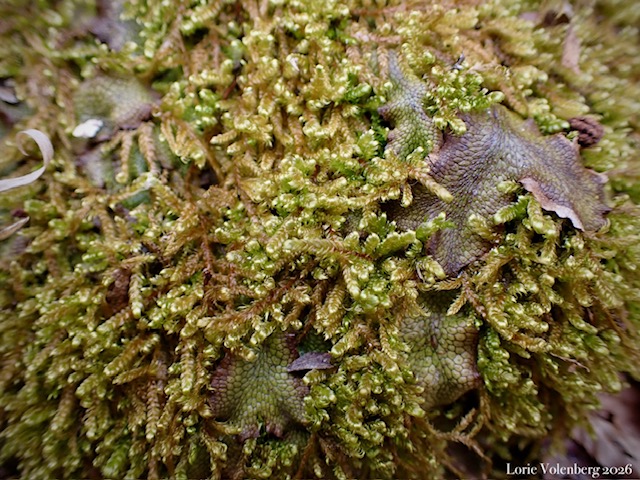
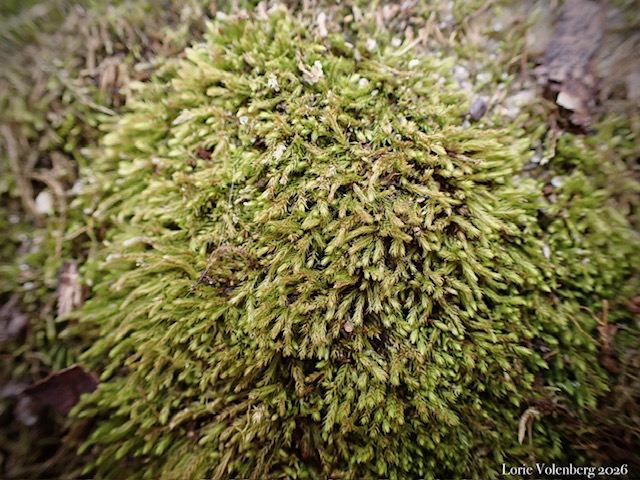
Left: Hypnum curvifolium (now Calliergonella curvifolia); Middle: Hypnum lindbergii (now Calliergonella lindbergii) showing off its winter golden color; Left: Hypnum sp. mixed with the snakeskin liverwort Conocephalum salebrosum.
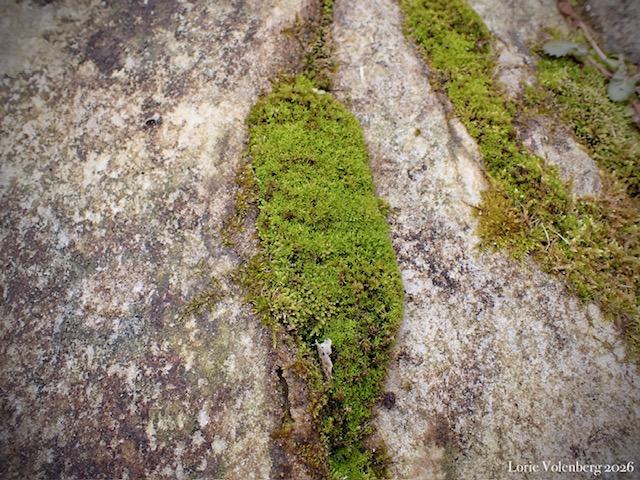
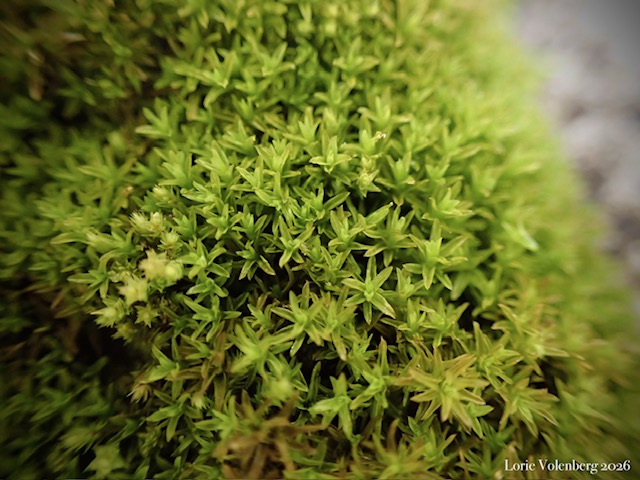
Left: Barbula unguiculata grows on thin soil that collected in a crack on the exposed sandstone bedrock; Right: Close up showing the lack of the distinct claw-like tips I am used to seeing on specimens in drier locations.
A new to me Philonotis specis
Growing on the bedrock in the creek I found smooth tufts of what appeared to be a Philonotis species. It seemed unusually small compared to what I have been used to seeing. Thankfully I collected it. Upon putting it under the microscope at home, the first thing I noticed were all the brood bulblets floating around! Only two of our species in Missouri produce propagules; P. marchica might produce propagules in the upper leaf axils, and P. gracillima (now P. hastata) produces brood branches or bulbils. Other features that helped to pinpoint P. gracillima as the species, were the rounded tips and small leaves (under 1.0mm). This is a new location for this S1 species, with only 4 other collections in the state.
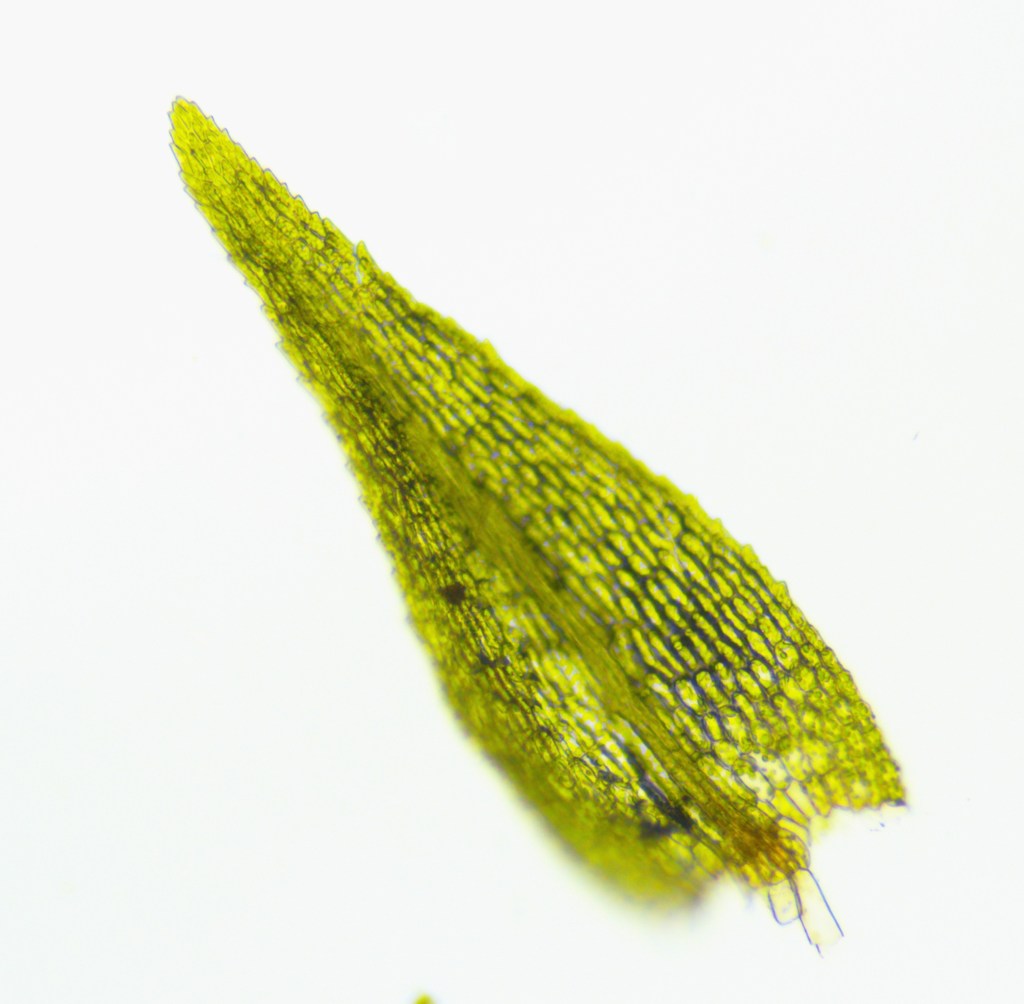
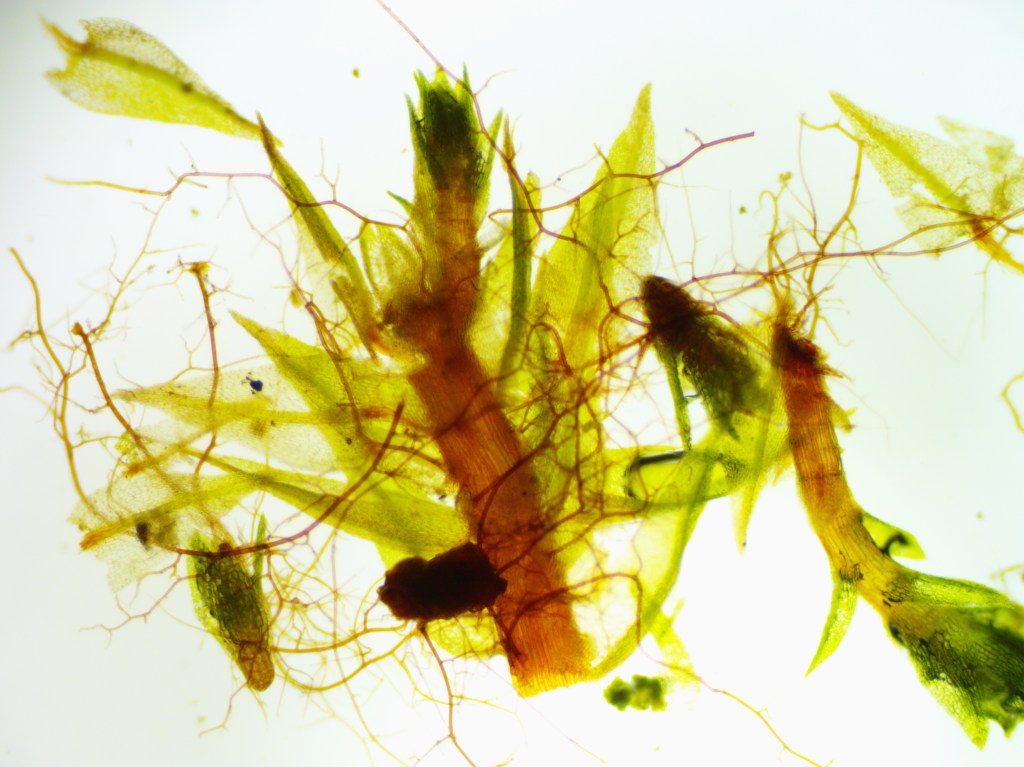
Left: Philonotis gracillima; Middle: Leaf under 1.0mm in length with rounded tip; Right: Brood branches and bulbils.
Moving up in time….
When we exited the creek bed, we started to hike up towards the limestone/dolomite formations above. However, before we transitioned, we came across a sandstone layer full of skolithos. We discussed how we tend to see this fossil layer near the top of the St. Peter Sandstone formations, and it is no different at Graham Cave SP. These are long tubes in the sandstone that were burrows of some creature that burrowed straight down into the sediment in a marine environment. Now, the moss takes advantage of these hollows, especially in pieces that have been flipped on their side, where hollows have accumulated soil and can hold moisture better.
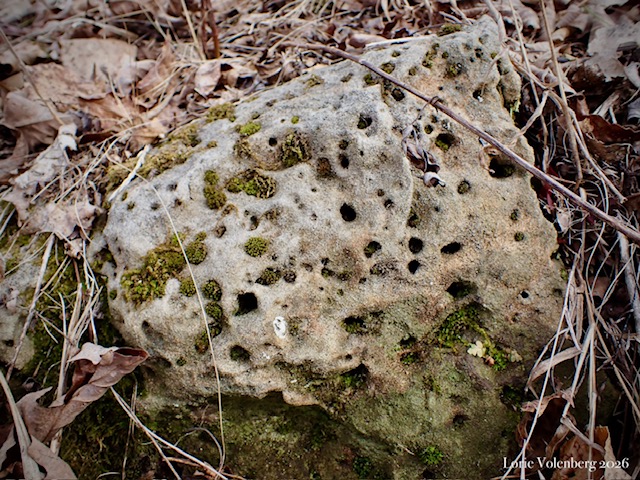
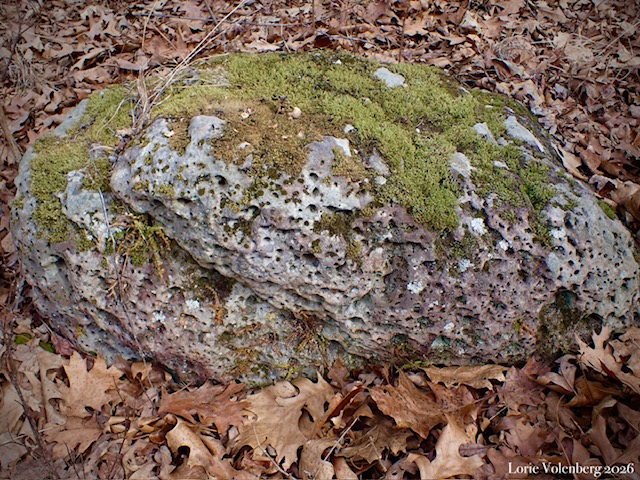
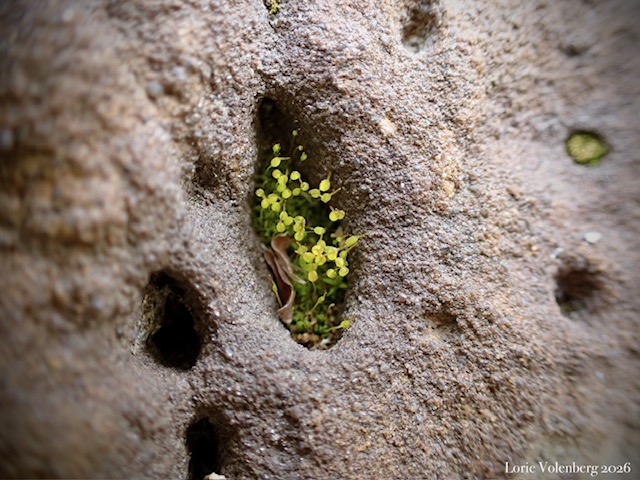
Left: Moss utilizing the microclimate offered by the skolithos; Middle: St. Peter Sandstone is often covered in a variety of mosses and liverworts such as seen here. The porosity of the sandstone allows for a foothold for the bryophytes, as well as holding onto moisture just a little bit longer due to the texture. Right: Weissia controversa happily growing in a skolithos.
The tiny Ptychomitrium incurvum was growing on some of the sandstone pieces.
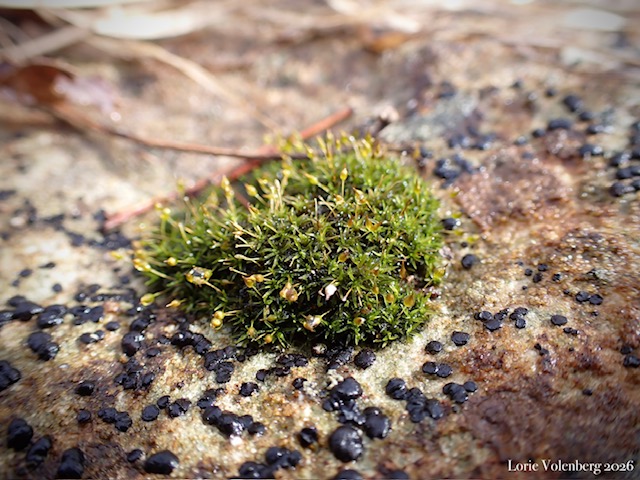
The windswept leaves are a dead give-away for Dicranum scoparium, and it is not unusual to find Leucobryum glaucum nearby. Both grow on the woodland floor in places where leaf litter dosen’t build up.
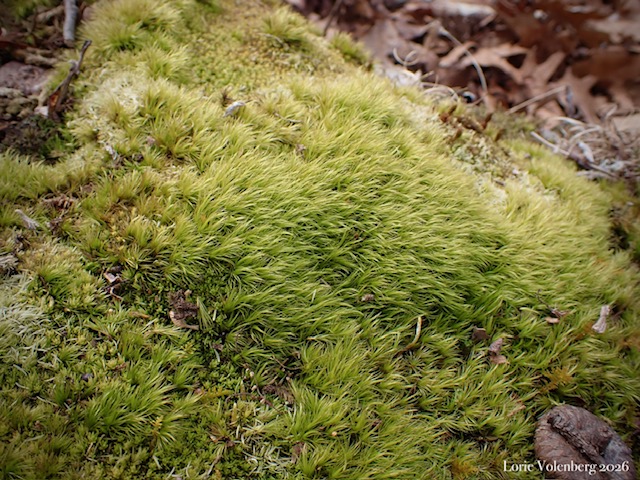
Once out of the St. Peter Sandstone layer, we hit a limestone/dolomite layer. Dolomite is a modified limestone by having a magnesium content CaMg(CO3)2, whereas “regular” limestone (CaCO3) does not. Dolomite is stronger and is more resistant to acid. Our geologists showed us that dropping a few drops of dilute hydrochloric acid on dolomite does not yield a fizzle, but when the surface is scratched to produce a powder, the powder reacted by producing a bubbling foam that is indicative of the calcium present. Dropping dilute hydrochloric acid on “regular” limestone will immediately produce a bubbling foam as it is more reactive to acid.
I noticed that mosses tended to grow in the cracks of dolomite-limestone where they could get a foothold, and water might collect for just a little while longer. On regular limestone, the mosses seem to be less picky where they grow.
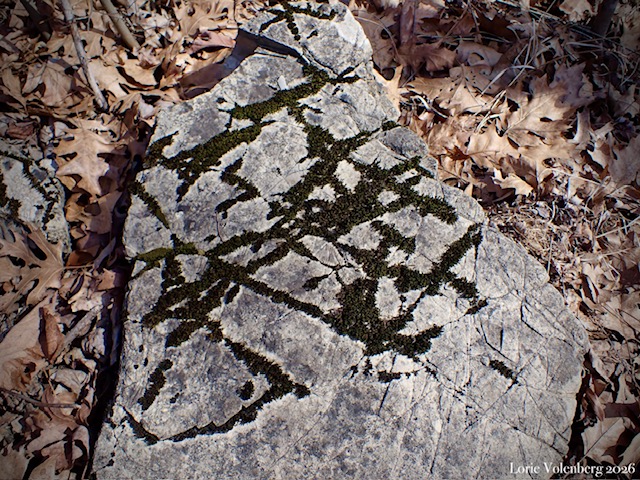
Once we entered the very large limestone/dolomite glades, we enjoyed our lunch, and I collected a few specimens such as Ditrichum linear and Gemmabryum caespiticum. There was an insanely large and majestic cedar tree that was left as a sentient, and it was rightly so, spared from the cedar clearing for the glade restoration. I now wished I had taken a picture of it, but me being me, I was immediately drawn into its limbs, looking at the mosses coating the bark. As always, Pylasia selwynii was there. I feel as though it could rightly be called an eastern red cedar tree obligate. Leucodon julaceus was the other common moss living on this ancient vascular being.
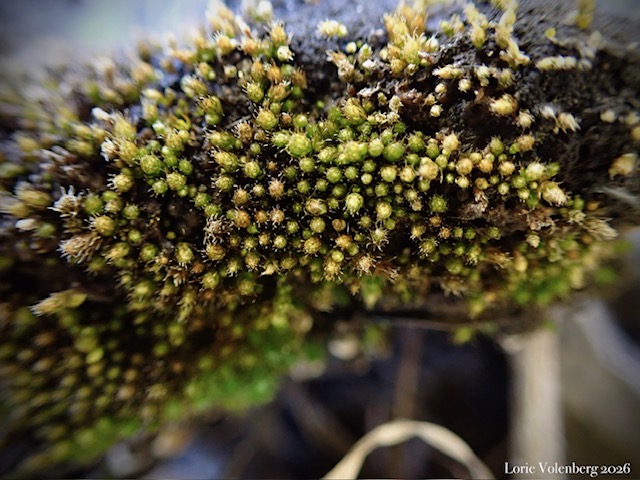
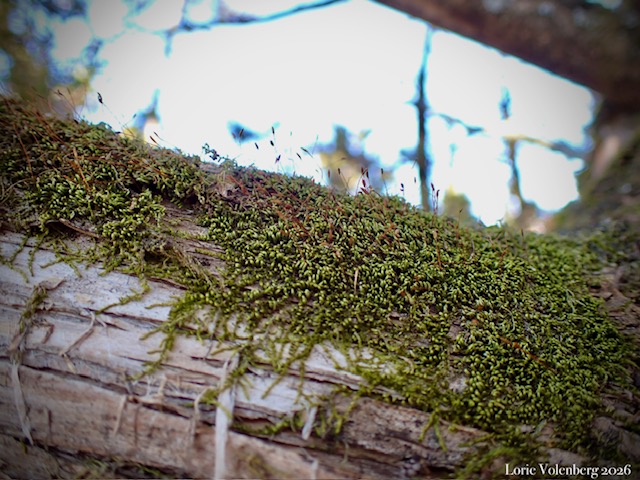
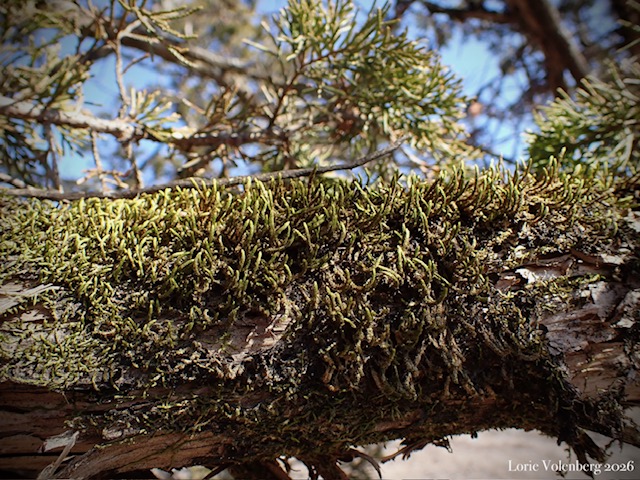
Left: Gemmabryum caespiticum, when starting to “turn silver”, can be confused with Bryum argenteum which can also be found in glades. The former will have a costa that extends into the awn; Middle: If there is a moss to be found on an eastern red cedar tree, it most assuredly will be Pylaisia selwynii; Right: Leucodon julaceus in its dry form.
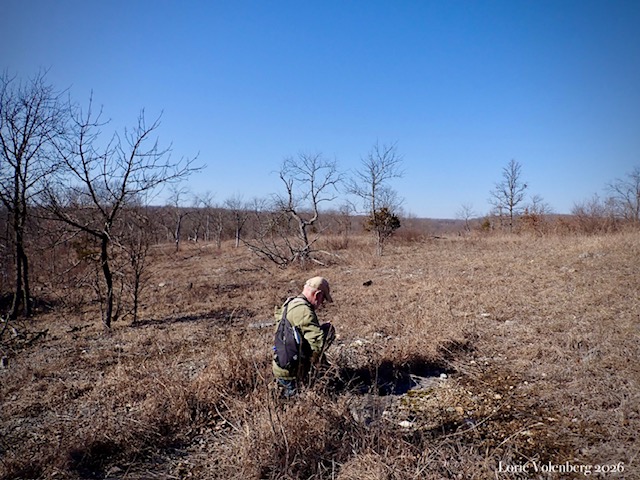
As we went higher yet, we surprisingly hit another layer of sandstone. This is where the history gets wonky, and I defer to my most expert geologists to attempt to explain the scenario. The sandstone for the most part, seemed similar to the St. Peter Sandstone we encountered lower in the landscape, except for this one, big, out of place, sandstone boulder. It was very, very solid. I noticed that there were few bryos or even lichens growing on it. The bryos were once again, relegated to cracks in the surface. Where exactly did you come from?
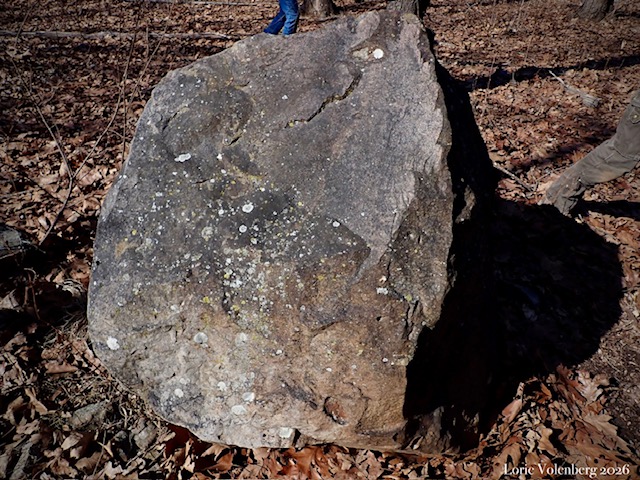
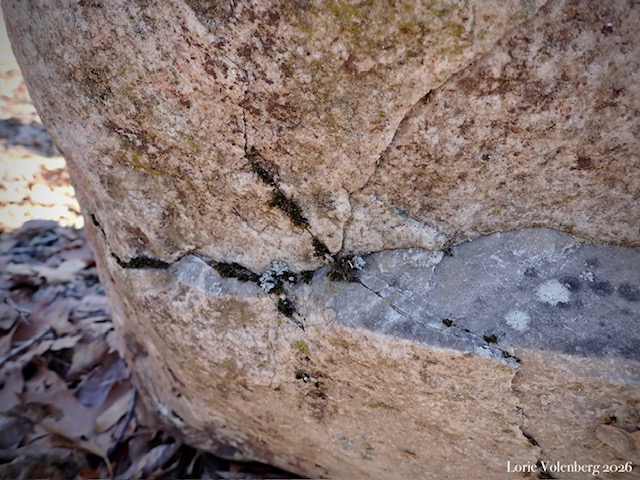
Mosses relegated to the cracks of this sandstone boulder.
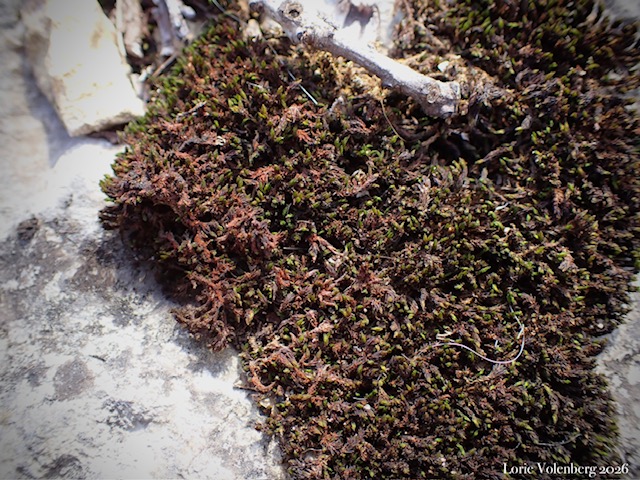
In the midst of all this exciting geology related bryophyte ecology, I came across a moss population that was covered in what looked like tiny orange droplets under the hand lens. From a regular view, the moss looked like it was covered in rust. I have leads on what I found, but I am doing some non-expert, really have no clue, experiments at home, to see if I can glean a little more information about this organism before I post about it.
It is always a joy to hang out with this group. Until next time, happy mossing!

 Mosses of Missouri and Beyond
Leave a comment